Mobility Data: Empowering CPG Companies with Privacy-First Location Intelligence

Blog

Mobility Data: Empowering CPG Companies with Privacy-First Location Intelligence

Geoff Michener
 Apr 17, 2025  •  5 min read

In the physical retail landscape, knowing where consumers go and how they move is no longer a luxury you can miss out on. It’s a must-have source of information. 

Mobility data has become the missing piece for Consumer Packaged Goods (CPG) companies to gain deeper insights into customer visitation patterns. This location-based intelligence shows not just where customers shop but how they move throughout the day—revealing patterns in visits, dwell times, and shopping frequency. This empowers CPG brands to make smarter decisions around product placement, distribution, and marketing strategies.

According to recent research from McKinsey, 71% of CPG leaders have said they leverage AI and advanced analytics in at least one area of business functions. Applying these tools to mobility data can boost margins and offer a significant competitive edge.

In this article, we’ll look at how mobility data transforms CPG operations, what to look for in a mobility data provider, and how dataplor’s privacy-first approach delivers comprehensive, high-quality insights without compromising consumer privacy. 

Mobility Data in Action: CPG Use Cases

Mobility data goes far beyond simple location tracking. 

For CPG companies looking to improve their market position and boost revenue, mobility data offers powerful opportunities to optimize performance by improving distribution, refining marketing strategies, and gaining deeper insights into customer behavior.

Understanding Consumer Behavior

Mobility data provides a real-world view of consumer visitation, delivering insights that traditional location data can’t.  When aggregated and analyzed correctly, this data shows:

  • How customers move between different locations
  • Dwell time in retail environments
  • Cross-shopping patterns between neighboring stores

For example, a beverage manufacturer might discover their target demographic visits fitness centers before grocery stores on weeknights. This intelligence could change their distribution and promotional strategies.

Optimizing Distribution Networks

For CPG companies, distribution efficiency is the bottom line. Mobility data helps manage logistics networks by showing:

  • High-traffic retail locations to stock priority
  • Regional variations in in-store visitation patterns
  • Best delivery routes based on store visitation peaks
  • Competitive density mapping

Travelers want directions they can rely on, and so do CPG logistics teams. When high-quality data informs distribution decisions, products arrive where needed most and when demand peaks.

Targeting Marketing Campaigns

Generic marketing rarely delivers good ROI. Mobility metrics, on the other hand, allow for hyper-targeted campaign planning:

  • Find complementary retailers for partnerships
  • Determine the best billboard and out-of-home advertising locations
  • Validate audience segments with real-world behavior

Measuring Campaign Effectiveness

Traditional campaign measurement is all about sales lift, but mobility data helps add much-needed context:

  • Track visitation patterns to retailers that carry your products
  • Compare store traffic before, during, and after promotions
  • Analyze competitive visitation from your campaigns
  • Measure actual footfall from specific marketing initiatives

For CPG brands, this closes the loop between marketing spend and in-store impact, allowing for continuous campaign optimization.

Choosing the Right Mobility Data Provider: Key Considerations

Not all mobility data is collected equally. In the same way that public agencies, cities, and private companies rely on shared languages and standards, a mobility data provider should offer clear and consistent data formats for easy integration and understanding.

Data Accuracy and Reliability

The foundation of any good mobility dataset is accuracy. Reliable directions require high-quality data inputs. Look for providers who:

  • Have rigorous data verification processes
  • Use multiple data sources for validation
  • Provide transparent methodology documentation
  • Have regular, documented update frequencies

Never compromise on quality—insufficient and inaccurate data can lead to poor decision-making, which can ripple throughout your organization.

Data Coverage

Comprehensive geographic coverage is key for CPG companies with a global footprint. It’s important to evaluate if the provider has:

  • National and global mobility data coverage
  • Rural and urban area representation
  • Multiple retailer types and categories
  • Consistent methodologies across different regions

The more complete the data, the better equipped you are to develop scalable solutions that support your entire market footprint.

Data Privacy and Compliance

With increasing regulatory scrutiny, privacy can’t be an afterthought. Look for providers who:

  • Never collect personally identifiable information (PII)
  • Implement rigorous data anonymization protocols
  • Follow GDPR and other regulations for compliance 
  • Filter out sensitive information and locations

A responsible provider ensures standardized, high-quality, and comprehensive processes that respect privacy while delivering valuable, actionable insights to businesses.

Maximizing the Value of Mobility Data

Acquiring mobility data is just the beginning. To unlock its full value, organizations should build capabilities across multiple dimensions.

However, many companies struggle to implement mobility data due to technical complexity, organizational silos, and analysis paralysis. 

To overcome these challenges:

  • Integrate data across systems: Connect mobility insights with your existing customer, sales, and inventory management platforms.
  • Build cross-functional teams: Bring together marketing, sales, supply chain, and analytics experts to interpret findings holistically.
  • Start with specific use cases: Rather than targeting an area that is too broad, begin with high-impact applications like new product launches or significant campaign optimizations.
  • Invest in visualization: Complex mobility patterns become accessible when visualized effectively and can improve the adoption of standardized formats across your organization.
  • Develop systemic solutions: Build long-term capabilities for mobility data use through clear processes, tools, and ongoing knowledge sharing.

Organizations that effectively operationalize mobility data can achieve greater ROI from their marketing investments compared to those who collect, but underutilize such data.

dataplor’s Mobility Data: Privacy-First Location Intelligence

At dataplor, we believe powerful insights shouldn’t come at the cost of privacy. Our approach to mobility data stands out through several key advantages:

Privacy-First Approach

Unlike some vendors who’ve faced legal challenges over privacy concerns, dataplor built privacy protection into its foundation:

  • Zero collection of personally identifiable information (PII)
  • Algorithmic filtering of sensitive locations
  • GDPR compliant methodologies

We don’t just comply with regulations; we exceed them with a fundamental commitment to ethical data practices.

Global Coverage with Consistent Methodology

CPG customers benefit from dataplor’s unmatched international coverage:

  • Standardized data collection across countries
  • Consistent schema for easy cross-market analysis
  • Comprehensive coverage beyond urban centers
  • Reliable mobility insights to support global expansion strategies

Our global mobility data enables accurate market comparison and strategy development across borders.

Actionable Intelligence

Raw data without context has limited value. dataplor transforms location signals into business intelligence:

  • Estimated visitor metrics derived from proprietary algorithms
  • Polygon-accurate location definitions
  • Time-based visitation patterns
  • Competitive benchmarking capabilities

Our estimated visitor count algorithm incorporates population density, signal frequency, and historical patterns to deliver accurate metrics without compromising privacy.

Customized for CPG Applications

We understand the unique challenges faced by CPG companies:

  • Retailer-specific intelligence
  • Category-level competitive analysis
  • Distribution optimization insights
  • Campaign effectiveness measurement

Our data bridges your business questions with actionable insights, powered by our location intelligence expertise.

Mobility Data: A Powerful Tool for CPG Success

As visitation patterns evolve over time, CPG companies with access to high-quality mobility data gain a major competitive advantage

By understanding physical world consumer journeys, optimizing distribution networks, targeting marketing efforts more accurately, and measuring real-world impact, they are set up for long-term growth.

dataplor’s privacy-first mobility data gives CPG companies the intelligence they need without the ethical and legal headaches that other providers face. Our global methodology, rigorous verification processes, and customized analytics deliver measurable business outcomes.

Ready to see how mobility data can transform your CPG business? Get in touch with dataplor today to learn how our privacy-first approach to location intelligence can help you understand consumer behavior, optimize operations, and grow in a competitive market.

Get the full story

Subscribe for the latest on location intelligence, places data, and the trends behind better business decisions.

Subscribe

Driving Retail Success: A Guide to Foot Traffic Analytics

Blog

Driving Retail Success: A Guide to Foot Traffic Analytics

Geoff Michener
 Apr 11, 2025  •  5 min read

Retail success goes beyond having a great product. It also relies on getting customers through the door. But how do retailers track foot traffic trends, identify patterns, and measure foot traffic in a way that drives insights? 

The answer is foot traffic analytics, a data-driven approach to understanding customer behavior in physical locations.

Foot traffic analysis is the process of examining external, aggregated foot traffic data to see how many visitors visit a specific location and how these patterns change over time. This data helps businesses optimize marketing, site selection, and the overall customer experience.

Studies show that over 80% of retail transactions still happen in physical stores, so it’s crucial to track foot traffic and analyze patterns. 

In this guide, we’ll look at the importance of foot traffic analytics, how businesses can use it to grow, and what to consider when choosing a foot traffic data provider like dataplor.

The Retail Landscape: Challenges and Opportunities

The retail world is undergoing a seismic shift. Traditional brick-and-mortar stores are battling on multiple fronts:

  • Unprecedented competition from e-commerce
  • Rapidly changing consumer behavior
  • Economic uncertainty
  • Technological disruption

Today, physical stores must compete not only with one another but also with digital marketplaces offering unmatched convenience and personalization.

Challenges for retailers include:

  • Changing Consumer Behavior: Shoppers no longer visit stores just to transact. They expect unique in-store experiences, seamless online-to-offline integration, and personalization. Retailers need foot traffic data to understand customer behavior and adjust their strategy accordingly.
  • Site Selection and Expansion Risks: Choosing the wrong retail location can be costly. Retailers need to analyze foot traffic patterns and demographic data to ensure they invest in the best locations that attract more visitors.
  • Competition and Market Saturation: With so many businesses vying for the same customers, understanding competitive foot traffic trends is key. Tracking foot traffic near competitor locations can give insights into market gaps and opportunities.

Retailers who use location intelligence and external foot traffic analytics can get a competitive edge by:

  • Identifying ideal locations for new retail stores
  • Refining marketing campaigns based on real-time traffic data
  • Configuring store layouts to get more customer visits
  • Using foot traffic patterns to improve operations

The Importance of Foot Traffic Analytics for Retailers

Foot traffic analysis is more than just counting how many visitors walk into a store. It gives a complete view of customer movement and engagement so businesses can make data-driven decisions.

Types of foot traffic data include:

  • Aggregated Pedestrian Counts: Measures overall foot traffic trends in and around a specific location.
  • Competitor Foot Traffic Data: Helps businesses understand consumer behavior at rival locations.
  • Trends Over Time: This includes tracking seasonal fluctuations, marketing campaign impact, and long-term visitation trends.

Why do retailers need this data?

  • High foot traffic = more customers. Footfall data helps businesses predict revenue.
  • Consistent traffic = loyal customers. Patterns show brand loyalty and customer engagement.
  • Sudden traffic changes = market shifts. A decline in foot traffic can mean an economic downturn or poor marketing efforts.

Strategic Applications: Turning Foot Traffic into Retail Advantage

Retailers should combine foot traffic data with demographic data, point of interest (POI) insights, and market data for the best advantage to their retail strategy.

  • Optimizing Site Selection: Choosing the right store location is key to success. Analyzing foot traffic and mobility data can show which areas have high commercial potential and steady customer visits. Retailers can avoid costly leasing mistakes by identifying higher foot traffic zones.
  • Hyperlocal Marketing: Retailers can use foot traffic data to tailor their marketing. By studying mobile location data, they can launch promotions when traffic is highest, boosting conversion rates.
  • Competitive Intelligence: Using foot traffic analysis, retailers can see competitors’ performance. If a nearby store sees a spike in customer data, it may indicate a successful marketing campaign or product launch from which businesses can learn.
  • Performance Evaluation: Measuring foot traffic data before and after an event, sale, or ad campaign provides valuable insights. Retailers can analyze foot traffic to adjust future marketing and operations.

Building a Holistic Retail Strategy

Retailers today face a complex landscape where estimating foot traffic isn’t enough. To stay competitive, they must combine accurate foot traffic analytics with a broader set of data-driven insights to create a retail strategy. 

By using multiple data sources—including POI data, sales performance metrics, and market trends—retailers can get a 360-degree view of customer behavior and optimize store operations.

Here’s how retailers can build a holistic retail strategy by understanding foot traffic so they can better target customers and gain valuable insights:

 1. Leveraging POI Data

A physical store doesn’t operate in isolation—its surroundings play a big role in driving customer visits. Point of interest (POI) data shows nearby businesses, attractions, transit stations, and landmarks that impact foot traffic trends.

How POI data helps: 

  • High-Traffic Locations: Stores near restaurants, gyms, or shopping malls will have more foot traffic than standalone locations.
  • Partnership and Collaboration: Knowing nearby businesses can help retailers explore cross-promotional opportunities (e.g. a clothing store offering discounts to gym members).
  • Competitor Analysis: POI data helps retailers see how competitor locations impact consumer behavior and if opening a store near a competitor would be a wise decision.

2. Aligning Sales Data with Foot Traffic Trends

Tracking foot traffic patterns is valuable, but businesses must also correlate these numbers with sales performance. A location with high visitor numbers but low conversion rates may indicate issues with store layout, pricing, or product selection.

How aligning sales data helps: 

  • Conversion Rate Optimization: By comparing foot traffic data with sales data, retailers can see what percentage of visitors buy and adjust their stores accordingly.
  • Product Placement: If an area of the store has high foot traffic but low sales, product placement or in-store promotions may need to be adjusted.
  • Traffic vs. Revenue Gaps: If a store has consistent foot traffic but declining sales, pricing, customer service, or inventory could likely be the issue.

 3. Benchmarking Against Market Trends and Competitors

External factors like economic trends, consumer spending habits, and competitor performance all impact success. To develop a holistic strategy, businesses must benchmark their foot traffic data against industry trends and competitor insights.

How benchmarking helps:  

  • Seasonal Trends: Comparing year-over-year foot traffic data helps businesses plan for peak shopping periods, staffing, and inventory adjustments.
  • Competitor Analysis: Monitoring foot traffic at competitor locations will show which stores are getting more customers and why.
  • Adapting to Market Changes: If a new shopping mall opens nearby and diverts foot traffic, businesses can adjust their marketing strategy to retain customers.

Vetting the Right Foot Traffic Analytics Provider

Choosing the right foot traffic data provider is key. Retailers should consider:

  • Data Reliability: How accurate and reliable is the foot traffic data?
  • Geographic Coverage: Can the provider track specific locations on a global scale?
  • Privacy Compliance: Does the data comply with data security laws?
  • Customer Support: Can businesses get help interpreting location data?

A quality provider offers reliable, privacy-first foot traffic data that businesses can trust to make informed decisions.

Transform Your Retail Operations with Foot Traffic Analytics

By using foot traffic analytics, you can:

  • Find the best places to expand in the physical world
  • Refine marketing campaigns with traffic data
  • Get a competitive edge by studying customer behavior
  • Optimize store layouts and operations 
  • Make strategic decisions with location intelligence

To succeed in today’s retail environment, you need to use foot traffic data to make better, data-driven decisions. 

Are you ready to get foot traffic data from a trusted provider to improve your store’s performance and success? Learn more about dataplor today, and contact us to start unlocking in-depth foot traffic insights.

Get the full story

Subscribe for the latest on location intelligence, places data, and the trends behind better business decisions.

Subscribe

Competitive Intelligence: Gaining an Edge with Location Data

Blog

Competitive Intelligence: Gaining an Edge with Location Data

Geoff Michener
 Apr 01, 2025  •  5 min read

Imagine anticipating your competitor’s next move before they even make it. What if you could see not just their plays, but the entire game board, revealing market shifts before they disrupt your business?

Many businesses today are in a cutthroat environment, and staying ahead isn’t just about gaining a competitive edge anymore; it’s about ensuring your survival. 

That’s where competitive intelligence comes in. 

By systematically collecting and analyzing data on competitors, market trends, and industry trends, businesses can make smarter decisions, seize hidden opportunities, and outmaneuver the competition before they even see it coming.

In fact, studies show that 61% of companies with formal competitive intelligence programs experience higher revenue growth than those without.

In this article, we’ll explore how location data fits into competitive intelligence, look at practical applications across industries, and show how dataplor’s global location intelligence solutions provide the valuable insights you need to win.

The Role of Location Intelligence in Competitive Analysis

Traditional competitive intelligence often misses a critical dimension: location. This covers where businesses operate, where customers shop, and how these patterns change over time, which provides invaluable context for decision making.

Location intelligence combines point of interest (POI) data, mobility insights, and geospatial analysis to give a 360-view of market dynamics. This turns raw geography data into actionable insights about competitor activity, customer behavior, and market opportunity.

For example, a quick-service restaurant chain planning expansion can use location intelligence to analyze competitor store density and foot traffic patterns to pinpoint areas with strong customer potential. This might show competitors clustering in downtown areas but neglecting suburban communities with the ideal customer profile—a clear opportunity for growth.

Research by McKinsey Global Institute supports the idea that data-driven organizations are 23 times more likely to acquire customers, six times as likely to retain customers, and 19 times as likely to be profitable.

Key Applications of Competitive Intelligence Heading

Competitive intelligence powered by location data provides a strategic advantage across key business functions, such as market analysis and site selection. Businesses can leverage these insights to identify untapped market opportunities, optimize their physical footprint, and refine targeted marketing campaigns.

Market Analysis

Location data allows businesses to conduct granular analysis and market research that are impossible through traditional methods. Companies can measure competitor presence across regions, track market share evolution, and identify underserved areas with significant potential.

For example, a national retail chain might find a competitor’s stores in the Northeast generate 40% more foot traffic than similar locations in the Midwest. This intelligence prompts them to investigate potential regional differences in marketing strategy or store operations. 

By understanding these variations, the retail chain can adapt its approach to each market’s unique competitive landscape, optimizing performance and maximizing market share.

Site Selection and Expansion

For businesses with physical locations, few decisions impact long-term success more than site selection. Traditionally, this was a process driven by intuition. Location intelligence, however, transforms it into a data-driven strategy.

A financial institution evaluating locations for new branches, for instance, can use competitive intelligence tools to analyze competitor branch networks, identify areas of high financial service demand but low business competition, and measure foot traffic patterns to optimize placement. This reduces risk and increases the chances of successful expansion.

Marketing and Sales Teams

Location-based competitive intelligence transforms marketing and sales strategies by showing where your new target market’s customers shop, how they move throughout their day, and which competitor messages they see.

Marketing teams can optimize billboard placements based on competitor ads and target customer commute patterns. 

Sales teams can focus on territories where key competitors are vulnerable and allocate resources where they will have the most impact.

Risk Management

Proactive risk assessment is a key part of competitive and strategic intelligence. Location data helps businesses identify threats from market saturation, economic shifts, or competitor expansion.

For example, a hospitality company tracking competitor locations might identify areas at risk of room oversupply. This crucial insight allows them to strategically delay or redirect their own expansion plans, avoiding costly mistakes and preserving resources for more promising opportunities.

Best Practices for Using Competitive Intelligence

Using competitive intelligence requires an effective strategy for data gathering, analysis, and application. Here are the best practices to keep in mind.

Selecting Quality Data Sources

The foundation of good competitive intelligence is good data. 

Some organizations try to use free resources like social media monitoring or crowdsourced databases like OpenStreetMaps, but these often yield incomplete or inaccurate results. 

Free data sources just can’t match the accuracy and reliability of professional solutions. In fact, decisions based on poor quality data cost US businesses over $3 trillion a year.

Professional data providers like dataplor offer significant advantages with rigorous verification processes, standardized data schemas, and global coverage. The differences become apparent when making million-dollar decisions based on location intelligence.

Implementing Robust Analysis Methods

Competitive intelligence hinges on the ability to extract actionable insights from complex data.

Modern competitive intelligence professionals leverage advanced analytics platforms and sophisticated visualization tools to extract meaningful insights from complex data sets. 

To ensure these insights are consistently captured, organizations must invest in a competitive data provider that offers frequent data updates, allowing for regular reviews of market share changes, competitor expansion patterns, and shifts in customer behavior.

Such consistent analysis allows businesses to identify critical trends before they become apparent to competitors, providing a significant strategic advantage.

Integrating Intelligence Into Decision Processes

To truly maximize value, competitive intelligence must seamlessly integrate into strategic decision-making processes.

This integration requires breaking down organizational silos and ensuring that actionable intelligence reaches key decision-makers in a timely and accessible format. 

Many successful businesses achieve this by establishing cross-functional competitive intelligence teams. These teams act as vital bridges, connecting critical market insights with strategic planning, product development, and sales initiatives. 

By ensuring that competitive intelligence directly influences business strategy, rather than becoming a mere academic exercise, these teams drive tangible results and maintain a competitive edge.

dataplor: Empowering Businesses with Competitive Location Intelligence

Many organizations know the importance of competitive intelligence but lack the targeted data to get meaningful location-based insights. This presents a significant challenge for businesses seeking to build robust, data-driven competitive strategies.

dataplor solves this problem by offering location intelligence solutions specifically for competitive analysis. Our global dataset has millions of points of interest across 250+ countries and territories with a standardized data schema.

What truly sets dataplor apart is data accuracy

Unlike crowdsourced alternatives, dataplor combines AI and large language model data collection with human verification to remove duplicates and errors. Our in-market experts provide language and cultural expertise to ensure data quality across multiple global markets.

For companies doing competitive intelligence across borders, dataplor’s international expertise is a major asset. Our experience with global location attributes, language variations, and cultural nuances ensure that you can confidently expand into any market with accurate and reliable location data.

Beyond location data, dataplor provides the dynamic insights you need for competitive analysis. Our mobility data offers an even deeper look into business performance, giving you foot traffic and visitation counts, popular times, and dwell times at competitor locations—all while upholding privacy standards and retaining no personally identifiable information.

Competitive Intelligence in the Age of Location Data

As markets grow more dynamic and competitive, the companies that will thrive are those that develop superior competitive intelligence capabilities. 

Increasingly, this means leveraging location intelligence, which provides unique context and customer insights that traditional research methods cannot replicate.

The most innovative companies know market intelligence isn’t just about tracking competitor activity but understanding the full competitive landscape through customer behavior, market trends, and geographic patterns. 

This is the difference between being able to anticipate rather than react to the market to ensure your business growth and make informed decisions. 

dataplor’s location intelligence solutions provide the foundation for this advanced competitive intelligence. 

Our accurate, complete, and privacy-compliant data lets you develop winning strategies based on real market insights, not assumptions or incomplete data.

Ready to transform your competitive intelligence through location data? dataplor has the global coverage, data quality, and expertise to give you a sustainable competitive advantage. Contact us today to discover how we can help your competitive intelligence initiatives.

Get the full story

Subscribe for the latest on location intelligence, places data, and the trends behind better business decisions.

Subscribe

Dry January Foot Traffic Trends: How Bars and Liquor Stores are Impacted

Blog

Dry January Foot Traffic Trends: How Bars and Liquor Stores are Impacted

Geoff Michener
 Mar 25, 2025  •  6 min read

Dry January isn’t just a personal challenge anymore—it’s a movement that’s changing the way Americans consume (or don’t consume) alcohol. What started as a niche trend has gone mainstream, with more people than ever choosing to take a break from drinking at the start of the year. And that shift is making waves for businesses that rely on alcohol sales.

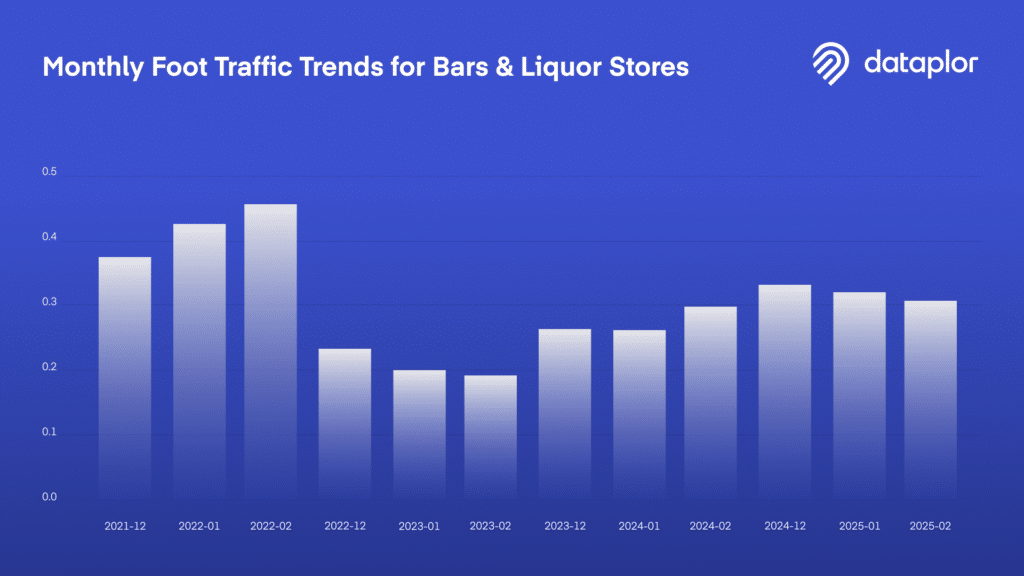
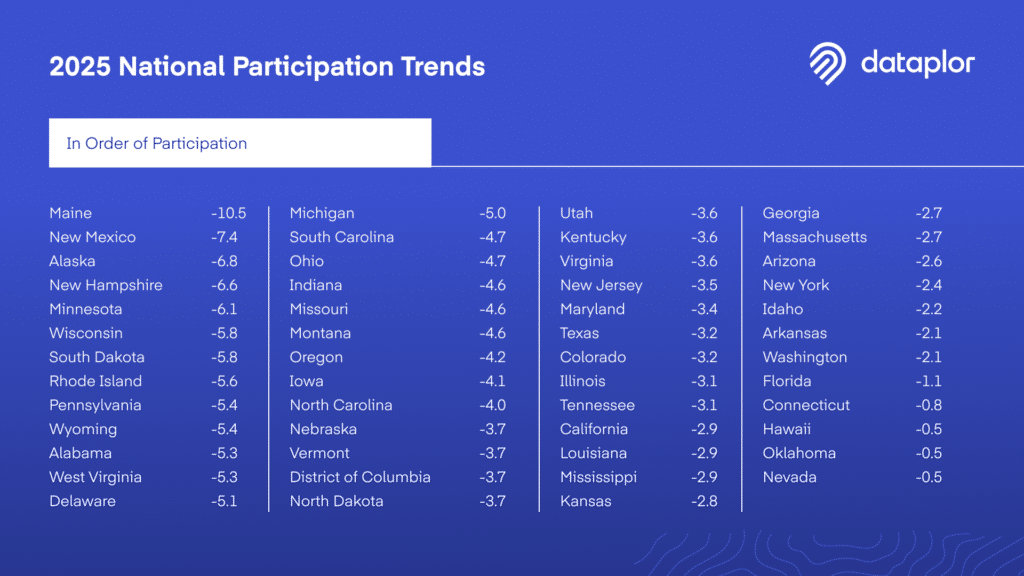
Bars and liquor stores, in particular, are feeling the impact, with changes in foot traffic that reflect evolving consumer habits. At dataplor, we dug into visitation patterns from December through February (2021-2025) to uncover the real story behind Dry January’s influence—spotting clear seasonal and regional trends that show just how much behavior is shifting.

Key Takeaways:

  • 2025 saw the most widespread Dry January adoption, with all states showing a decline in bar and liquor store visits from December to January.
  • Bars remain more resilient than liquor stores, likely due to their social atmosphere and non-alcoholic offerings.
  • Certain states, like Maine and South Dakota, consistently show larger declines, reflecting stronger Dry January participation.
  • Other states, such as New Mexico and Louisiana, displayed greater variability, suggesting that factors like local events and weather may play a role in foot traffic trends.

Seasonal Trends: The Rise of Dry January

Analyzing month-over-month foot traffic for bars and liquor stores from December through February across multiple years (2021-2025) revealed several key patterns:

  • There was no significant Dry January effect in 2021-2022, likely due to post-pandemic social activity boosting bar visits.
  • 2022-2023 showed the first clear Dry January impact, with a noticeable drop in January and a slower recovery in February.
  • 2023-2024 saw a similar January decline, but February rebounded quickly, suggesting only temporary behavior changes.
  • 2024-2025 displayed a moderate drop in January, followed by a continued decline in February, indicating a sustained shift in drinking habits.

These trends suggest that Dry January has transitioned from a niche health challenge to a widely recognized movement affecting consumer behavior.

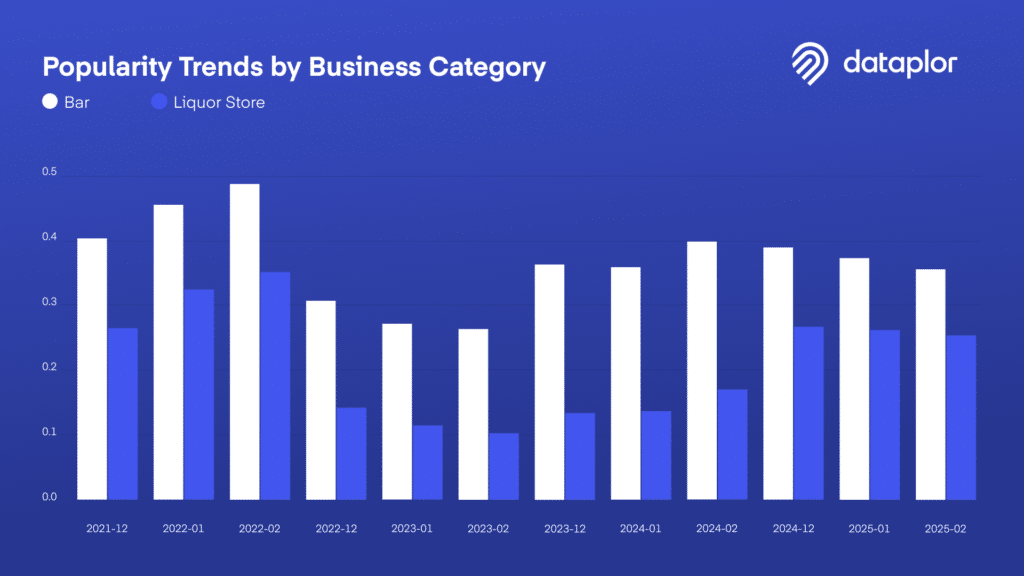
Bars vs. Liquor Stores: Who’s Getting Hit the Hardest?

Comparing bar and liquor store visits over the December–February period highlights key differences in how these businesses are affected:

  • Bars continue to attract more visitors and maintain steadier traffic throughout the winter months.
  • Liquor stores peaked in early 2022 and have seen a decline since, with a slow recovery starting in late 2023.
  • Bars show more resilience due to their diverse offerings, including food, social environments, and non-alcoholic beverage options.
  • Liquor stores face greater volatility as consumers cut back on alcohol purchases during Dry January.

These findings indicate that while Dry January influences alcohol consumption, bars may weather the trend better than retail liquor stores.

Regional Trends: Dry January Adoption by State

A state-by-state analysis of foot traffic changes from December to January reveals regional differences in Dry January participation:

  • All states had bars and liquor stores that saw some level of decline, reinforcing the nationwide adoption of Dry January.
  • Maine and South Dakota consistently experienced the largest drops, suggesting strong engagement in the movement.
  • New Mexico, Louisiana, and Indiana showed more variability, likely due to local events, seasonal weather, or other external factors.

These variations highlight how Dry January adoption isn’t uniform across the U.S., with certain states embracing the trend more aggressively than others.

Year-Over-Year Growth: Is Dry January Here to Stay?

Analyzing four years (2022-2025) of state-by-state participation levels provides insight into Dry January’s growing influence:

  • Maine consistently exhibited strong Dry January participation, with significant drops in bar and liquor store visits each year.
  • 2025 marked the strongest and most widespread Dry January adoption, with every state showing declines in foot traffic.
  • 2023 displayed trends similar to 2025, suggesting that Dry January participation has been steadily increasing.

As Dry January becomes more mainstream, bars and liquor stores may need to adapt their offerings to retain customers during this period. Given the sustained growth of Dry January, bars and liquor stores should consider new strategies to maintain customer engagement:

  1. Expand Non-Alcoholic Offerings – Many consumers are reducing alcohol intake but still want to socialize. Adding mocktails and premium non-alcoholic options can keep foot traffic steady.
  2. Promote Social Experiences – Bars that emphasize live music, trivia nights, and food pairings can attract customers who are abstaining from alcohol.
  3. Leverage Seasonal Promotions – Liquor stores may benefit from promoting Dry January-friendly options like non-alcoholic beer, wines, and spirits.
  4. Understand Regional Variations – Knowing how Dry January impacts different states can help businesses tailor their marketing efforts accordingly.

The numbers are in, and Dry January isn’t slowing down. In fact, 2025 marks the biggest year yet for participation. Bars are holding their own, thanks to their social draw, but liquor stores are seeing more ups and downs as consumers rethink their alcohol purchases.

Mobility data tells the full story, highlighting where and when these changes happen. For businesses, staying ahead means using these insights to refine their marketing strategies and adjust their approach. As Dry January continues to reshape the industry, those who pay attention to the trends will be the ones that thrive.

Get the full story

Subscribe for the latest on location intelligence, places data, and the trends behind better business decisions.

Subscribe

Leverage Location Data to Outsmart Your Competition

Blog

Leverage Location Data to Outsmart Your Competition

Geoff Michener
 Mar 13, 2025  •  5 min read

Imagine a fitness retailer launching a new line of running shoes. Instead of blanketing the city with generic ads, they use location intelligence to target their ideal customers. 

By analyzing foot traffic data around parks, gyms, sporting goods stores, and competitor locations, they identify areas with a high concentration of runners and fitness enthusiasts. They then deploy hyperlocal digital ads and partner with local fitness influencers in those areas, creating buzz among their target audience, driving traffic to their stores, and maintaining a competitive edge in the market. This personalized experience isn’t magic; it’s the power of location analytics, a technology revolutionizing how businesses connect with customers.

This isn’t “just another tech trend”. We’re witnessing an explosion in the industry, with the global location analytics market set to surge from $18.30 billion in 2023 to a staggering $64.85 billion by 2032, according to Fortune Business Insights.

Flying blind on location data is like navigating with your eyes closed. Companies that ignore these geographical insights are losing marketing dollars and watching their market share slip away to more savvy competitors.

However, businesses that harness location intelligence insights are transforming their operations, from optimizing customer engagement and streamlining logistics to mitigating risk and making informed expansion decisions.

In this article, we’ll reveal how forward-thinking companies use location analytics to leave their competition in the dust and how you can be more current with the industry’s demands. We’ll also explore how dataplor can empower your business with the accurate, comprehensive, and dynamic location data you need to succeed.

The Power of Localized Location Data

Imagine having a clear view of your customers’ visitation trends, along with detailed information about the businesses they visit—like hours of operation, location, and more. This is the power of location intelligence—a game-changing resource that empowers businesses to make data-driven decisions and achieve unprecedented growth.

Let’s explore how resourceful companies leverage location intelligence to transform customer connections, optimize operations, and gain a competitive edge in today’s dynamic marketplace.

Beyond Basic GPS

Traditional GPS coordinates only tell part of the story. Today’s location intelligence goes far beyond simple mapping, combining consumer visitation data with information on that specific business location. This empowers businesses to understand not just where customers visit, but key details about the business itself. 

By leveraging location data, companies can track everything from foot traffic patterns and popular visiting times to how a business is performing. This granular level of detail unlocks a deeper understanding of target audiences and enables data-driven decision-making.

Consider your local shopping district. Location-based data reveals which stores attract the most visitors and how long they stay. These insights enable brands to craft targeted marketing campaigns that resonate with real-time customer preferences. 

Use Cases

Let’s break down how different sectors use location-based marketing to revolutionize their operations.

Marketing and Sales

Location intelligence empowers marketers to go beyond broad demographics and understand the where and why of customer behavior. This insight allows for highly targeted campaigns that resonate with specific audiences.

Here’s how businesses can leverage location data to revolutionize their marketing and sales strategies:

  • Identifying Prime Locations for Marketing Campaigns: By analyzing POI and mobility data, businesses can identify areas with a high concentration of their target audience. This allows them to focus their marketing efforts on the locations where they are most likely to be effective.
  • Optimizing Advertising Spend: Location intelligence helps businesses understand where their ideal customers are visiting, allowing them to allocate their advertising budget more effectively. This ensures their message reaches the right people at the right time, maximizing ROI.

Operations

Location intelligence empowers businesses to optimize their operations, improve efficiency, and make data-driven decisions across various aspects of their business.

Here’s how companies can leverage location data to transform their operations:

  • Optimizing Delivery Routes and Logistics: By analyzing road networks, high-traffic areas, and delivery destinations, businesses can optimize delivery routes and schedules, reducing transportation costs and improving delivery times.
  • Strategic Site Selection and Expansion: Location intelligence helps businesses identify optimal locations for new stores, warehouses, or distribution centers based on factors such as competition, accessibility, and proximity to transportation hubs.

Risk Management

Location intelligence plays a crucial role in helping businesses assess and mitigate risks associated with specific locations. dataplor’s data empowers companies to make informed decisions and minimize potential threats to their operations and investments. 

Here’s how businesses are leveraging location data for risk management:

  • Assessing Investment Risks: Investors can use location data to analyze specific locations’ economic health and stability before making investment decisions. By understanding factors such as business survival rates, foot traffic patterns, and competitor activity, investors can gain valuable insights into the potential risks and rewards of investing in a particular area.
  • Evaluating Market Suitability: Businesses can leverage location intelligence to evaluate the suitability of new markets before expanding their operations. By analyzing factors such as consumer behavior and competitor presence, companies can make informed decisions about market entry and reduce the risk of failure.
  • Optimizing Security Measures: Location intelligence plays a crucial role in helping businesses assess and mitigate risks, particularly in the financial sector. By analyzing location data in conjunction with transaction patterns and customer behavior, companies can identify irregular or suspicious activities and enhance fraud detection capabilities.

How to Leverage Location Data to Beat the Competition

Navigating without location data is no longer enough. To truly outperform the competition, companies need to leverage location intelligence to drive strategic decision-making and operational efficiency.

By analyzing location-based insights, companies can refine their marketing strategies, optimize operations, and make data-driven decisions to maintain an edge. 

Here’s how to use location data to outperform the competition.

Data-Driven Decision Making

Businesses need to make informed decisions based on accurate and timely data. Location intelligence empowers companies to move beyond guesswork and leverage real-time geographic insights to optimize strategies, identify opportunities, and allocate resources effectively.

For example, retailers can use location-based data to find gaps in the market, such as areas with high customer demand and no supply. By analyzing factors such as population density, customer visitation trends, competitor presence, and accessibility, businesses can pinpoint prime locations for new stores, distribution centers, or service areas.

In logistics, optimizing resources becomes easier with real-time location intelligence. By route planning, analyzing peak traffic times, and optimizing resource allocation, 3PL companies can eliminate inefficiencies and secure more business. 

Location data provides valuable insights into customer behavior, allowing businesses to personalize their offerings and optimize customer experiences. For example, a restaurant chain can use location data to analyze peak visitation hours at different locations, ensuring adequate staffing levels to provide efficient service. 

By using location data, businesses can gain a competitive edge, optimize operations, and make data-driven decisions that drive growth and profitability. 

Competitive Analysis

Understanding your rival’s geographic footprint is crucial. Location intelligence empowers brands to go beyond surface-level observations and delve deeper into competitor activity, market share dynamics, and customer overlap. This analysis helps companies tailor content and services to underserved areas.

By mapping competitor locations against foot traffic patterns and points of interest, businesses can pinpoint underserved areas with high potential. For example, a fast food chain can analyze competitor locations and identify areas with a higher foot traffic but a limited presence of similar restaurants. 

Market share analysis combined with location intelligence can show which businesses dominate certain areas. A retail brand might find that a competitor has a stronghold in urban areas but has a limited footprint in suburban markets. This location data can assist with expansion decisions to capture a larger market share. 

Moreover, customer overlap analysis allows businesses to refine their marketing strategies. If two competing coffee shops share a significant portion of their audience, one can leverage location data to offer targeted promotions or loyalty programs to customers near their competitor’s location, enticing them to switch brands. 

Using location data for competitive analysis, businesses can identify growth opportunities, develop targeted strategies, and ultimately outperform their rivals.

Personalized Customer Experiences

Delivering personalized customer experiences is key to building brand loyalty and driving customer engagement. Location data allows businesses to understand customer visitation trends and preferences, tailoring interactions and offerings for a more relevant and engaging customer journey.

Here’s how businesses can leverage location data to personalize the customer experience: 

  • Targeted Marketing and Promotions: By analyzing customer demographics, location data, and foot traffic patterns, businesses can create targeted marketing campaigns that resonate with specific customer segments. This ensures that marketing messages are relevant, timely, and delivered to the right audience.
  • Tailored Recommendations: Understanding consumer behavior through location data allows businesses to provide more relevant product or service recommendations. By analyzing customer preferences in different locations, companies can tailor their offerings to meet their target audience’s specific needs and interests. 
  • Enhancing Customer Engagement: Location data can create more engaging and interactive customer experiences. 

By using location-based insights, businesses can create stronger connections with their target audience, increase engagement, and boost conversion rates—all while delivering the most relevant content to individual customers.

Gain a Competitive Edge with dataplor’s Location Data

Leveraging location data is no longer optional—it’s a powerful tool for businesses looking to outsmart the competition. From optimizing marketing strategies to outpacing the competition, the right location-based data provides the insights needed to stay ahead.

At dataplor, we empower businesses to transform raw location data into actionable intelligence. Our cutting-edge technology and meticulous data verification processes ensure that you receive reliable and up-to-date information.

With dataplor’s location intelligence, you can make data-driven decisions that enhance customer engagement, optimize operations, and drive growth and profitability.

Ready to leverage location data for a competitive advantage?

Contact us today with any questions you may have, or request a free data sample to discover how dataplor can help you unlock the power of location-based data for your business. 

Get the full story

Subscribe for the latest on location intelligence, places data, and the trends behind better business decisions.

Subscribe

Fast-Food Foot Traffic Trends: What Movement Data Reveals About America’s Favorite Chains

Blog

Fast-Food Foot Traffic Trends: What Movement Data Reveals About America’s Favorite Chains

Geoff Michener
 Feb 02, 2025  •  5 min read

Discover how scarcity and regional loyalty drive America’s favorite fast-food brands.

Americans love fast food, but how can we know which offerings are really the most popular? At dataplor, we know it’s the numbers that unlock deep insights. We recently put this to the test by analyzing foot traffic trends among America’s most popular fast-food chains, as part of the launch of our new mobility product. 

Combining extensive point-of-interest (POI) data with footfall counts, our location intelligence product equips businesses with deep insights into consumer interactions with specific locations. The mobility product gives businesses information to help optimize their decision-making using its foundation of 3.9 trillion movement data points.

Our analysis was centered on three questions: 

  • Based on how often a restaurant is ranked in the “Top 5” in foot traffic in a given state, which brands seem to be the most popular?
  • Based on how often a restaurant is ranked in the “Top 5” for the total number of stores in a given state, which brands are the most ubiquitous?
  • Based on how often the restaurant is ranked first for foot traffic in a given state, which brands are the most well-loved?

The results showcased surprising results, answering the question, “Do more locations always equal greater customer loyalty and increased foot traffic?”


Nationwide, Bigger Does Not Always Mean Better

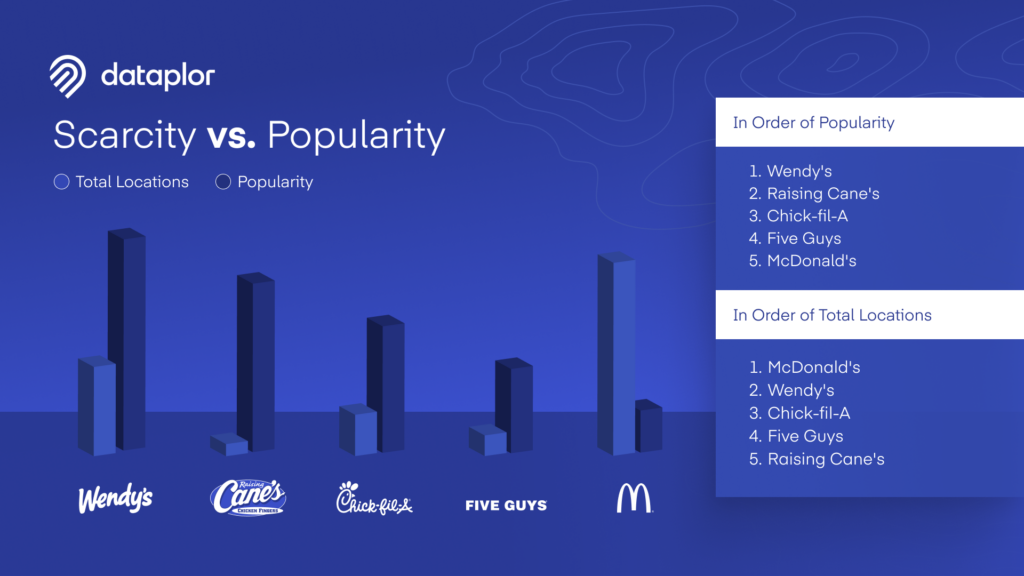
On the national scale, Wendy’s led as the most popular chain in terms of foot traffic, followed by Raising Cane’s, Chick-fil-A, Five Guys, and McDonald’s. McDonald’s and Subway tied as the most widespread chains overall, with Burger King, Wendy’s, Dairy Queen, and Sonic Drive-In rounding out the list. Only two of those most common restaurants (Wendy’s and McDonald’s) are also present in the top five for most foot traffic, suggesting that being everywhere doesn’t mean you’re going to be everyone’s top choice.

So, which brands are winning hearts and stomachs across the nation?

Scarcity may make the stomach grow hungrier. Wendy’s and Raising Cane’s took the top two spots for “most likely to be ranked first for foot traffic in a state” nationwide, followed by In-N-Out Burger, a tie between Chick-fil-A and Culver’s for fourth, and Five Guys in fifth. Yet looking at those brands that rank first in foot traffic in at least one state, only Wendy’s is in the top five nationally for the most locations.

Regional Favorites Roundup

Southeast

Mirroring national trends, Wendy’s led in foot traffic in the Southeast, followed by McDonald’s, Raising Cane’s, Chick-fil-A, and then a tie between Five Guys and Culver’s. And once again, being ubiquitous doesn’t necessarily translate to popularity, with Subway, Burger King, Sonic, and Dairy Queen all appearing on the list for most common stores, yet absent from the top foot traffic rankings.

West

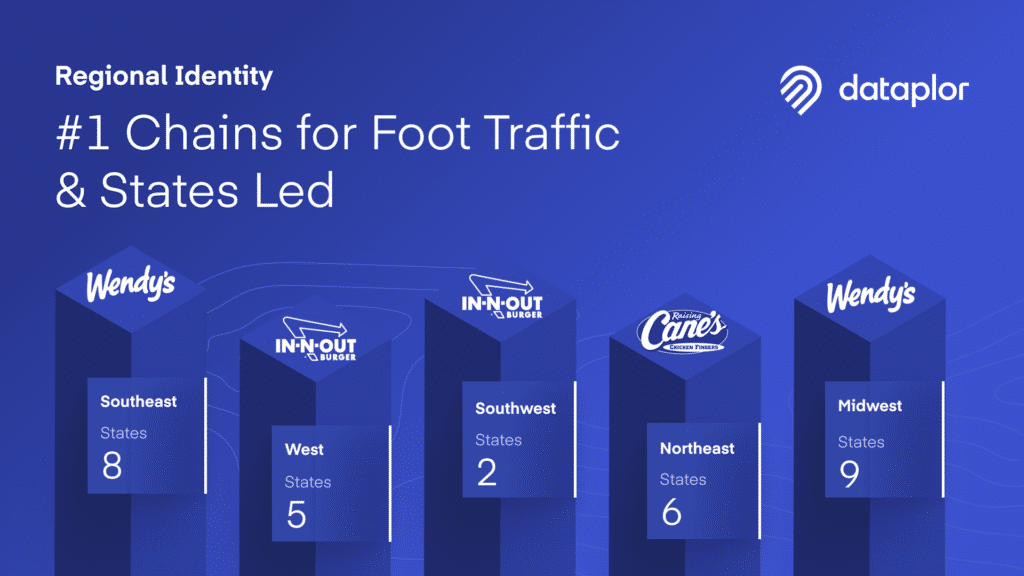
Perhaps unsurprisingly, regional favorite In-N-Out Burger secured a number-one ranking in five Western states for having the highest foot traffic—despite not cracking the top five for total number of stores in any state in the region. Taking a broader view of brands that achieved a top five ranking for foot traffic in at least one Western state, In-N-Out ties for fourth place with fellow burger joint Five Guys, with the top spots belonging to Wendy’s, Chick-fil-A, and Raising Cane’s.

Southwest

Maintaining its western dominance, In-N-Out also stood out as a beloved chain in the Southwest region. It once again achieved the most first-place rankings for foot traffic in a given state, taking the top honor in two of the four states in the region. Interestingly, the list of brands to make the top five for foot traffic in at least one state in the Southwest were: Wendy’s, Raising Cane’s, McDonald’s, Five Guys, In-n-Out, Culver’s, Chick-fil-A, and Freddy’s Frozen Custard and Steakburgers; yet of these, only Wendy’s and McDonald’s ever make the top five for total number of stores in at least one state.

Northeast

Five Guys, founded in Washington, D.C., and Jersey Mikes, native to the Jersey Shore, demonstrated a strong presence in the area close to their origins, ranking second and third in the region in terms of the number of times they crack the top five for total number of stores in a given state. When it comes to overall popularity, Wendy’s, Chick-fil-A, and Five Guys took the top three spots for stores most likely to rank in the top five for foot traffic. But Raising Cane’s emerged as perhaps the most well-loved restaurant, taking the top spot for foot traffic in a whopping six states in the Northeast.

Midwest

Wisconsin-born Culver’s excelled in its home region, showing up in the top five for both number of locations and foot traffic. It’s the second-most likely brand, behind Wendy’s, to be in the top five for foot traffic for states in the region, snagging the number one overall spot for popularity in one state (Ohio).

How Mobility Insights Can Drive Smarter Business Decisions

The fast-food study uncovered compelling patterns regarding consumer behavior that highlight what genuinely resonates with customers.

  • The Scarcity Factor: Chains like Raising Cane’s and In-N-Out demonstrate how there’s not always a correlation between a restaurant’s footprint and popularity. Even with a smaller geographic footprint, these restaurants showcased high foot traffic, suggesting strong customer loyalty.
  • The Power of Regional Loyalty: Local favorites took hold in their home regions. Culver’s, rooted in the Midwest, Five Guys, with origins in the Northeast, and In-n-Out in the West all indicate how regional ties help brands outperform more prominent competitors.
  • Popularity Isn’t Always About Numbers: A larger presence doesn’t always translate to greater popularity. Consumers often prioritize regional connection and brand identity over convenience or location count.

dataplor’s mobility product offers actionable data for businesses across industries. This fast-food analysis revealed how businesses can use location intelligence to optimize marketing strategies with tailored campaigns for regional preferences, identify gaps in high-loyalty regions to explore new markets, and understand consumer behavior to inform store placement and product offerings.

Learn more about our mobility product and how your business could benefit from these insights in our mobility release announcement.

Get the full story

Subscribe for the latest on location intelligence, places data, and the trends behind better business decisions.

Subscribe
dataplor Partners with Esri to Deliver Smarter Global Location Intelligence Solutions

Blog

dataplor Partners with Esri to Deliver Smarter Global Location Intelligence Solutions

Geoff Michener
 Dec 18, 2024  •  2 min read

MANHATTAN BEACH, Calif. — Dec 18, 2024

dataplor, the leading global geospatial data company specializing in Point of Interest (POI) data, is excited to announce it has joined the Esri Partner Network (EPN) as a Bronze partner. Esri is the global market leader in geographic information system (GIS) software, location intelligence, and mapping. This collaboration aims to provide customers with enriched geospatial insights, combining the strengths of both companies to empower businesses with advanced tools for strategic decision-making worldwide.

Retailers, CPG brands, financial institutions, tech companies, and third-party logistics providers rely on dataplor for comprehensive and precise POI data to assess competitive landscapes, select new sites, and identify markets ripe for expansion. The EPN partnership with Esri will further empower these users with sophisticated location intelligence, enabling them to unlock deeper insights into market trends, investment opportunities, and risk mitigation strategies across various geographies and timeframes.

With a global network of 3,000 partners, Esri’s EPN partners help customers around the world utilize the benefits of ArcGIS software and location intelligence. For over 50 years, Esri partners have supported users with business solutions, implementation services, and dynamic content by leveraging GIS technology across every industry.

“The partnership with Esri represents a significant step forward in our mission to provide the most accurate and actionable geospatial data available,” said Geoff Michener, founder and CEO of dataplor. “Combining Esri’s ArcGIS software with dataplor’s high-quality POI data offers businesses unparalleled insight into where to focus their efforts and investments to achieve sustainable growth.”

dataplor is distinguished in the geospatial data sector by its exclusive focus on POI data and its rigorous data verification processes. While much location data is plagued by inaccuracies from unreliable open-source data and inconsistent records, dataplor employs advanced machine learning algorithms, AI-driven call bots for local business validation, and local human experts to resolve data ambiguities.

In the past year, dataplor has expanded its database to over 370 million POIs across more than 250 countries and territories, offering unmatched global coverage. Leading Fortune 500 companies, real estate investors, financial institutions, insurers, and local communities leverage dataplor’s data to identify strategic opportunities, mitigate risks, and drive success. By partnering with Esri, dataplor will further enhance its ability to provide businesses with powerful location intelligence solutions to optimize their market strategies.

Contact media@dataplor.com for more information.

Get the full story

Subscribe for the latest on location intelligence, places data, and the trends behind better business decisions.

Subscribe
What is Geospatial Intelligence? A Guide for Businesses

Blog

What is Geospatial Intelligence? A Guide for Businesses

Geoff Michener
 Dec 10, 2024  •  6 min read

Geospatial intelligence, or (GEOINT) refers to the integration of geographic information and technology—such as satellite imagery, remote sensing, and Geographic Information Systems (GIS)—to derive insights from spatial data. GEOINT captures data from the Earth’s surface to support decision-making across various industries. 

Originally used by the intelligence community, including the U.S. military and national security agencies, GEOINT now plays a vital role in helping businesses worldwide to make informed decisions, ranging from disaster response to market entry.

The National Geospatial-Intelligence Agency (NGA) was initially known for delivering intelligence products and analysis through aerial imagery and mapping services. However, with the rise of big data, geospatial intelligence has expanded beyond its traditional use. Today, many industries leverage geospatial data to turn complex data into actionable insights, transforming business practices and decision-making.

The geospatial analytics market is expected to reach $141.9 billion by 2028, making GEOINT a key focus for businesses worldwide.

This article covers the basics of geospatial intelligence, its sources and applications, and how businesses are using it to stay ahead. We’ll also explore how dataplor fits into the geospatial arena and how you can benefit from our solutions. 

What is Geospatial Intelligence?

Geospatial intelligence is the combination of geographic data, spatial analysis, and information management to produce insights.      

These insights are used by decision-makers worldwide to understand and respond to complex situations, from national security to business strategy.

Here are some of the main components of geospatial data: 

  1. Geographic Data: The foundation of GEOINT is geographic data, which is information about the Earth’s surface and its features. This data is gathered through various means, such as satellite imagery, aerial photography, remote sensing, and even social media check-ins, providing a rich, multi-dimensional view of any area.
  2. Spatial Analysis: Once geographic data is collected, spatial analysis processes it to uncover patterns, trends, and relationships. Using mathematical and statistical techniques, spatial analysis reveals how different geographic elements interact. This approach is applied in areas such as identifying the best locations for business expansion, imagery intelligence, and analyzing environmental changes.
  3. Information Management: Geospatial intelligence involves managing large volumes  of data. Information management systems organize, store, and process GEOINT data to ensure it is accurate, accessible, and actionable. High-resolution datasets, mapping software, and cloud-based tools also allow analysts to interpret information quickly and provide real-time insights to decision-makers.

However, it’s important to understand the difference between geospatial intelligence and Geographic Information Systems. Although they are closely related, GEOINT and GIS serve different purposes. 

  • GIS is a tool for collecting, storing, and visualizing geographic data, often in the form of maps or layered visual representations. 
  • Geospatial intelligence, on the other hand, takes GIS data and applies spatial analysis and information management techniques to generate insights for strategic decision-making. 

In essence, while GIS is a system for handling geographic data, GEOINT is the analysis and intelligence derived from that data.

The Benefits of Geospatial Intelligence

GEOINT gives you valuable insights to change how you approach strategy, operations, and risk management in your business. 

By combining geographic data, spatial analysis, and information management, GEOINT enables informed decision-making based on real-world, location-specific information.

Here are the main advantages:

  1. Better Decision Making: GEOINT gives you high-resolution, data-driven insights into market conditions, customer behavior, and operational performance across geographic areas. You can use these insights to choose the best locations for new store locations, evaluate supply chain logistics, and allocate resources where they’ll have the most impact.
  2. Better Operational Efficiency: GEOINT helps optimize routes, plan resource allocation, and anticipate customer demand based on geographic patterns. For logistics and supply chain companies, this often translates to reducing fuel costs and delivery times. In utilities or telecommunications, it supports coordinating infrastructure repairs and upgrades based on location-specific needs.
  3. More Market Understanding: Geospatial data provides a 360-degree view of your market, revealing demographic trends, spending patterns, and competitor locations. With this data, you can tailor your marketing campaigns, identify high-potential markets, and personalize customer experiences based on location-specific characteristics.
  4. Risk Management: Geospatial intelligence helps you identify and manage risks related to natural disasters, market volatility, and security threats. Using tools like remote sensing and satellite images, you can anticipate weather-related disruptions, assess regional stability, plan for contingencies, and protect your assets and workforce.

For industries where location knowledge is crucial—such as retail, real estate, logistics, and finance—geospatial intelligence gives you a competitive edge by turning geographic information into a strategic advantage.

The Role of Location Data in Geospatial Intelligence

It’s no surprise that reliable location data is the foundation of geospatial intelligence. 

The value of GEOINT lies in the accuracy, depth, and relevance of the geospatial data, which turns raw location information into actionable insights for decision-making.

By providing real-time, location-specific data, you can make strategic decisions based on a comprehensive understanding of geographic and spatial factors.

Geographic Features

Geographic features like terrain, elevation, water bodies, and infrastructure form the foundational layer of geospatial intelligence. 

This data, sourced from tools like GIS, helps businesses and analysts visualize physical environments and gain a deeper understanding of the geographical context surrounding operational areas.

Remote Sensing Imagery

Remote sensing imagery captured from satellite or aerial platforms provides an up-to-date, high-resolution view of specific locations. 

You can also obtain intelligence and insights across various sectors, from urban planning to crop health to disaster impact. 

Remote sensing helps businesses track changes over time, which is invaluable for industries such as real estate, agriculture, and national security.

Location Data

Location data from devices, social media, and GPS allows businesses to analyze real-time customer behavior, movement patterns, and population density. 

By using location-based insights, businesses can personalize marketing, optimize site selection, and refine customer engagement strategies based on where their target audience lives, works, and spends time.

These three types of geospatial data collectively enhance the overall geospatial intelligence picture, providing valuable context, insights, and the ability to predict future trends. 

By combining these data types, you can make GEOINT a powerful tool for location-specific decision-making.

Empower Your Organization with dataplor’s Geospatial Data

Whether through open source or other means, geospatial intelligence (GEOINT) is a valuable asset for businesses looking to incorporate location-based insights into their strategic decision-making, operational efficiency, and market understanding. 

In today’s data-driven world, where precise and actionable information is more crucial than ever, the importance of quality geospatial data continues to grow.

dataplor’s geospatial data solutions help organizations to maximize the value of  GEOINT, offering high-resolution, real-time insights tailored to their business needs. From site selection to customer engagement, decision-makers can rely on dataplor’s solutions and tools to stay informed and ahead of the competition.

Ready to elevate your organization with cutting-edge geospatial intelligence? 

Explore dataplor’s data solutions and see how we can support your growth. 

Reach out today for a consultation or request a data set sample to experience the dataplor advantage firsthand.

Get the full story

Subscribe for the latest on location intelligence, places data, and the trends behind better business decisions.

Subscribe
Future Mapping: Unveiling Tomorrow’s Opportunities

Blog

Future Mapping: Unveiling Tomorrow’s Opportunities

Geoff Michener
 Nov 22, 2024  •  6 min read

Future mapping is a strategic tool that helps organizations anticipate and plan for future trends by visualizing possible scenarios and outcomes. This methodology allows businesses to align their goals with the evolving market, navigate uncertainty, and capitalize on new opportunities. 

In a world where change is the only constant, future mapping can be the key to making the right decisions and future-proofing your business.

A report from the World Economic Forum states that 85 million jobs will be displaced by a shift in work between humans and machines by 2025. Not only does this highlight the need for businesses to adapt, but it also underscores the importance of innovation to stay competitive

The good news is that future mapping can empower you to visualize industry changes and prepare accordingly. 

In this article, we will explore how future mapping works, its applications across different sectors, and how companies like dataplor lead the way with advanced location data solutions. 

Understanding Future Mapping

Future mapping is a strategic approach that enables organizations to navigate uncertainty and capitalize on opportunities in a changing landscape, enhancing goal achievement. 

Here are the essential components of the future mapping process.

Key Components of Future Mapping

  • Trend Analysis: This is the process of identifying and analyzing the trends that will impact an organization. By examining market patterns, technological advancements, and socioeconomic shifts, businesses can gain insight into the forces shaping their industry. This is most commonly used in fintech.
  • Scenario Planning: Scenario planning is a key part of future mapping that involves creating detailed stories about possible future scenarios. Businesses can prepare for different possibilities by considering different variables and their outcomes. This helps increase adaptability and responsiveness to changing circumstances.
  • Risk Management: Understanding risk is key to future mapping. By identifying uncertainties and vulnerabilities in their operations, businesses can develop strategies to mitigate those risks and stay stable and resilient in the face of challenges.
  • Opportunity Finding: Future mapping helps organizations find emerging opportunities that align with their strategic goals. By identifying market gaps and innovative solutions, businesses can stay ahead of the competition and unlock new opportunities for growth.

Benefits of Future Mapping for Businesses

  • Better Decision Making: Future mapping provides a structured framework that helps decision-makers evaluate all possible outcomes and trends, enabling more informed, strategic choices.
  • More Innovation: Companies that engage in future mapping are more likely to have an innovative culture. By exploring different scenarios and opportunities, businesses can encourage creative thinking and develop products and services that meet future needs.
  • Less Risk: With a clear understanding of potential risks and uncertainties, companies can develop effective mitigation strategies. Future mapping enables companies to anticipate challenges and create contingency plans, resulting in a more robust business model.

The Role of Geospatial Data in Future Mapping

Geospatial data is a key part of the future mapping process; it provides the foundation for the insights needed for smart planning. By using geospatial data, organizations can better understand their environment and make more strategic decisions. 

Here are some of the key ways geospatial data powers future mapping.

Analyzing Spatial Patterns and Trends

Geospatial data allows businesses to analyze spatial patterns and trends that may not be visible through other data sources. 

By visualizing this data, organizations can uncover insights into customer preferences, market dynamics, and demographic changes. 

Spatial analysis is crucial for identifying trends that may impact future operations, allowing businesses to adapt their strategies accordingly.

Identifying Emerging Hotspots and Opportunities

Geospatial data enables organizations to pinpoint emerging hotspots—areas experiencing rapid growth or change.

By mapping geographic information, companies can identify areas with increasing demand for their products or services, resulting in more targeted marketing and resource allocation.

This proactive approach to identifying opportunities gives businesses a competitive edge and eases entry into new markets. 

Assessing the Impact of Location-Based Factors

Location-based factors are crucial to business success. 

Geospatial data allows organizations to see how different factors—such as proximity to suppliers, transport networks, and the competitive landscape—impact their operations. 

By understanding the geographical context of their business environment, organizations can make better decisions around site selection, distribution strategy, and supply chain management.

Modeling Future Scenarios Based on Geographic Data

Geospatial data enables organizations to model future scenarios. 

With high-quality data, a comprehensive future map can be created for one year, three years, or even further. 

Businesses can simulate outcomes based on different variables by combining different datasets, such as demographic projections, economic forecasts, and environmental conditions. 

Scenario modeling also helps prepare for different possibilities by drawing on past experiences and trends, making planning more concrete and aiding in navigating uncertainty. 

dataplor’s Geospatial Data

dataplor offers a range of geospatial data solutions to support accurate future mapping, empowering you to leverage location intelligence to make informed decisions. With consistently reliable and comprehensive location data, dataplor gives you the insights needed to navigate the future.

Here are some of the key features and benefits.

Accurate Geospatial Data

dataplor provides accurate geospatial data that captures the essential information about an area. 

This level of detail allows you to analyze spatial patterns and trends more accurately to make better decisions. 

Whether it’s urban development, market trends, or demographic changes, dataplor’s up-to-date data puts the insights you need right at your fingertips.

Advanced Spatial Analytics

dataplor’s comprehensive data allows you to explore geospatial data in your platform of choice.

By integrating this data with tools to identify correlations and visualize data trends, you can extract meaningful insights to guide your business and investment strategy

This analytical power helps you understand how spatial factors impact your business, allowing you to adjust your approach for the best results.

Integration with Other Data Sources

One of the key benefits of dataplor’s offering is the ability to integrate geospatial data with other relevant data sources. 

This holistic approach allows you to combine location intelligence with customer data, market research, and operational metrics to get a 360-degree view of your business. 

By combining multiple data streams, you can make more informed decisions that take into account more relevant factors.

Future Mapping Begins with dataplor

More than ever, businesses need future mapping as a tool to anticipate key trends and opportunities. By integrating geospatial data into the process, companies can achieve successful outcomes through informed decision-making, innovation, and reduced risk. 

Analyzing spatial patterns, assessing the impact of location-based factors, and modeling future scenarios based on geographic data are vital for navigating uncertainty and charting a course for success.

dataplor’s suite of geospatial data provides organizations with the tools to create valuable future maps. With accurate location data and advanced spatial analytics, dataplor gives businesses the tools needed to visualize and understand the complex interplay of geographic factors impacting their goals.

Ready to take the next steps and create your own vision of the future?

Get in touch to unlock the power of geospatial data in real-time with dataplor. 

Whether you want to find new real-world opportunities, assess risk, or improve your strategic planning, dataplor is here to help. You can also explore our case studies to see how we’ve helped other brands achieve success.

Get started on your action plan today!

Get the full story

Subscribe for the latest on location intelligence, places data, and the trends behind better business decisions.

Subscribe

Data Enrichment Strategies: A Focus on POI Data

Blog

Data Enrichment Strategies: A Focus on POI Data

Geoff Michener
 Nov 12, 2024  •  7 min read


The digital world is constantly developing and evolving, and in today’s competitive landscape, many businesses struggle with the challenges of limited data insights. Relying on raw data alone often leads to gaps in understanding customer preferences and missed opportunities in targeted marketing.

Customer expectations evolve with time, making it vital to seek out deeper data insights from your existing data to maintain an edge. This is where data enrichment becomes essential, allowing you to enhance the quality of your datasets and make informed decisions that drive the growth of your business.

A recent study reveals that businesses investing in data enrichment experience a 20% improvement in their ability to understand customer behavior and preferences. This enhanced understanding can empower you to refine your marketing strategies, tailor your messages, and optimize the efforts of your sales teams, leading to positive and measurable results.

In this article, we’ll review the fundamentals of data enrichment, explore how dataplor’s POI data enhances the data enrichment process, and provide some real-world use cases and examples of how businesses have achieved success using enriched datasets.

What is Data Enrichment?

Data enrichment is the process of adding additional information to existing datasets to improve their quality, accuracy, and completeness. For instance, if you’re evaluating customer data, you may want to include elements such as appending external data or first-party data, contact data, or third-party data—such as demographic data, contact information, and firmographic data—to existing customer data. 

By enriching raw data with high-quality information from various data sources, you can turn incomplete or outdated data into actionable insights, improving the overall value of your data management and validation processes. Data cleansing tools can help you ensure that this enriched data is accurate and ready for use in making business decisions.

Here’s why data enrichment is important for your business:

1. Complete Market View

With data enrichment, you can achieve a complete view of your market by combining existing data with external data sources. This allows you to track competition, identify new opportunities, and validate business decisions.

Having enriched datasets allows you to analyze trends in real-time and make informed decisions based on comprehensive insights.

2. Better Customer Segmentation

Enriching customer profiles with demographic and firmographic data enables you to segment your audiences more precisely. This deeper understanding of customer needs and preferences allows for more effective targeted marketing efforts.

It ensures that your marketing teams can deliver personalized messages that resonate with distinct groups, improving the overall customer experience.

3. Optimized Marketing Campaigns

By enhancing CRM and marketing databases with high-quality data, you can optimize your marketing strategies

For instance, enriching customer data with insights from POI data allows you to craft campaigns that are more aligned with consumer preferences, ultimately boosting conversion rates and enhancing customer relationships.

4. Smarter, Data-Driven Decisions

With enriched datasets, you can make data-driven decisions based on comprehensive, quality data. This helps fine-tune sales efforts, improve workflows, and boost overall efficiency.

Having access to data enrichment tools like dataplor ensures that every piece of information is validated, accurate, and ready for action, providing a solid foundation for strategic decision-making.

How POI Data Supercharges Data Enrichment

POI (Point-of-Interest) data refers to detailed information about specific physical locations such as restaurants, retail stores, landmarks, and other notable places. This data offers insights into various locations, their operating details, and surrounding areas. With POI data, you can gain a deeper understanding of geographic contexts, which play a crucial role in targeted marketing and customer segmentation efforts.

POI data is a valuable source of information that enables you to enrich your current datasets with comprehensive details about surrounding locations. The result is a more detailed and holistic view of your customer’s environment.

POI data can be used to enrich existing data by adding valuable contextual information that offers you a statistical edge. Here’s how:

1. Business Longevity and Local Attractions

By integrating POI data with your customer data, you can gain insights into the longevity of businesses in a given area and nearby attractions that add value to the location.

Understanding which types of businesses have a long-standing presence—such as high-end retail stores or family restaurants—can help you craft targeted marketing messages and refine your outreach efforts. Utilizing these insights into established businesses and popular attractions can elevate your marketing strategies and boost conversion rates.

2. Competitor Proximity and Complementary Businesses

Understanding the proximity of competitors or complementary businesses around a given POI can help you tailor your sales and marketing strategies. 

For example, if a competitor is located nearby you can create lucrative offers to lure customers or offer complementary services that enhance your customer relationships. This information, combined with third-party data, enables informed decisions and allows you to stay ahead in competitive markets.

Incorporating POI data into your data enrichment process not only enhances the quality of your datasets but also gives you deeper insights into market trends, customer behavior, and local competition. This enriched data is particularly valuable if you’re focused on enhancing third-party logistics, helping you optimize delivery routes, and improving operational efficiency.

By leveraging this additional information, you can make smarter, data-driven decisions and optimize your sales teams and workflows accordingly.

3. Customer Movement Patterns

Foot traffic data provides a detailed view of your customer’s environment by uncovering movement patterns and behaviors in real time. When combined with POI information, it reveals critical insights about foot traffic trends. This integration allows you to see how customers interact with specific locations, including the most frequented times and high-traffic areas. By understanding how your target customers move within an area, you can refine customer segmentation, optimize marketing efforts, and allocate resources more effectively, ensuring your efforts resonate with real-world behaviors.

By understanding the proximity of competitors or complementary businesses, you can craft targeted offers to attract customers or provide additional services that strengthen your relationships with them. Additionally, by integrating mobility and POI data, you gain deeper insights into customer movement patterns, local business longevity, and nearby attractions, helping to further refine your strategies. This information, combined with third-party data, enables informed decisions and allows you to stay ahead in competitive markets.

Examples of Data Enrichment with POI Data (Use Cases)

To illustrate the impact of POI data on data enrichment, let’s explore some real-world examples from various industries. From optimizing site selection to enhancing marketing strategies, various businesses across different sectors have successfully leveraged enriched datasets to gain a competitive edge.

These use cases demonstrate how you can harness the power of POI data to make smarter decisions, improve operational efficiency, and unlock new growth opportunities.

1. Tensorflight: Optimizing Real Estate Site Selection

Tensorflight, a tech company specializing in property analytics for the insurance industry, turned to dataplor to enhance its real estate data for more accurate property evaluations. By integrating dataplor’s POI data with their proprietary models, they were able to improve the geocoding accuracy and refine building occupancy and tenant type classifications.

This enriched data helped Tensorflight provide insurers with more detailed property insights, ensuring that building replacement costs and occupancy risks were calculated with greater precision. The collaboration led to significant improvements in data-driven decision-making for property insurance, enabling more accurate real estate assessments.

2. IKEA: Streamlining Delivery for Better Customer Service

IKEA, known for its large-scale furniture retail operations, significantly improved its last-mile delivery efficiency by leveraging geospatial data and investing in advanced software to optimize delivery routes. 

Through route planning and monitoring of truckloads, IKEA Retail Denmark was able to pilot a program that reduced delivery times and operational costs. This focus on data-driven logistics resulted in streamlined processes and improved customer satisfaction by ensuring timely deliveries.

Empower Your Data Enrichment Journey with dataplor

In today’s data-driven and competitive world, staying ahead requires making timely, well-informed decisions. Data enrichment is no longer a luxury you can conveniently ignore; it has become a necessity for gaining a deeper understanding of your customers, optimizing market strategies, and driving operational efficiencies.

By enriching existing datasets with high-quality, accurate information, you can unlock the true potential of your business data. And that’s where our advanced and comprehensive POI data comes into play.

With our comprehensive location data, we provide you with the tools you need to stay competitive in your industry. Whether you’re enhancing customer profiles, improving decision-making, or optimizing workflows, dataplor’s POI data delivers valuable insights that can propel your business forward.

Request a sample to explore our location intelligence solutions and learn how our data enrichment services can take your business to new heights. 
Learn more about us and start your journey with dataplor to harness the power of data enrichment.

Get the full story

Subscribe for the latest on location intelligence, places data, and the trends behind better business decisions.

Subscribe