

Blog
Bridging the data gap between the digital and physical worlds


Digital engagement has never been easier to measure. Brands can track clicks, impressions, app opens, reviews, and social interactions in near real time. But as digital analytics have become more sophisticated, a critical blind spot has grown alongside them: understanding what actually happens in the physical world.
For many organizations, performance is still evaluated primarily through online behavior. Yet revenue, growth, and competitive advantage are ultimately driven by real-world activity: where customers go, which locations succeed, and how physical environments shape outcomes. Closing the gap between digital signals and physical reality is now one of the most important challenges facing data-driven teams.
Why the digital–physical divide is growing
Consumers increasingly move fluidly between online and offline experiences. They research products online, engage with brands on social platforms, read reviews, and build shopping carts—then make decisions that may or may not result in a store visit. Digital intent does not always translate into physical action.
At the same time, many organizations have overcorrected toward digital-only measurement. Online engagement is easier to capture, faster to analyze, and often treated as a proxy for success. But without real-world context, those signals can be misleading. A strong digital presence does not guarantee foot traffic, and online hype does not always indicate that a location, market, or expansion strategy is working on the ground.
What gets missed when teams focus only on digital metrics
When performance is evaluated through digital analytics alone, entire categories of customer behavior go unmeasured. Store visits, trade-area dynamics, competitive proximity, and physical constraints such as store size or co-location within a building are often excluded from analysis.
These blind spots matter. Two locations with similar online engagement can perform very differently in the real world based on their surrounding environment. A brand expanding into a new city may see strong digital interest, but without understanding local foot traffic patterns, nearby competitors, or neighborhood characteristics, that interest may never convert into sustainable performance.
This lack of offline context frequently leads to misinterpretation. Teams may assume a market is underperforming when the issue is location-specific. Others may overestimate opportunity based on online buzz without validating whether real-world conditions support growth.
How location intelligence connects digital signals to physical outcomes
Accurate point-of-interest and foot traffic data provide the missing link between online behavior and physical reality. By precisely identifying places in space and keeping those records continuously updated, location intelligence enables teams to see what is actually happening on the ground.
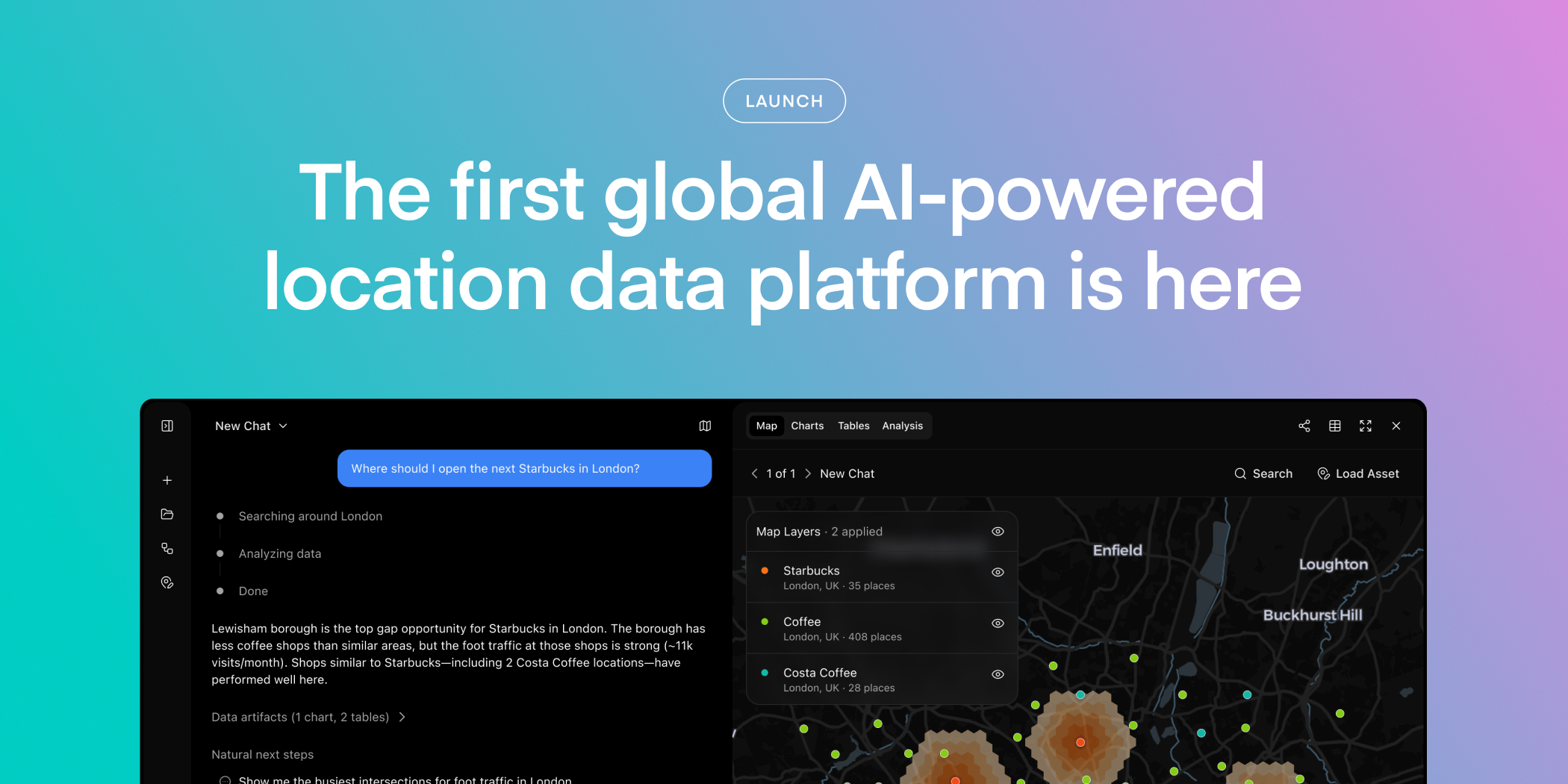
Fresh places data matters because the physical world changes constantly. Stores open and close, brands relocate, and categories shift within shared buildings. Layer foot traffic onto accurate places inside a defined trade area and you can see where demand concentrates, where competitors intercept it, and where white space remains. And leaning on an AI-driven platform can turn that work into a question you ask, with the answer back in seconds.
When this physical foundation is in place, digital signals become far more valuable. Online engagement, reviews, check-ins, and operating hours can be analyzed alongside visitation trends, proximity to competitors, and surrounding place attributes. Together, these datasets create a more complete picture of demand, performance, and opportunity.
Benefits of unified data
Bridging digital and physical data unlocks better decision-making across industries.
Retailers and consumer brands gain clearer attribution by understanding whether digital campaigns actually drive store visits. Quick service restaurants can evaluate trade-area shifts, validate expansion strategies, and compare performance across markets using consistent real-world benchmarks. Investors and financial services teams can move beyond surface-level signals to assess brand health, expansion velocity, and competitive dynamics using observed physical activity.
Across all use cases, the outcome is the same: more confident forecasting, sharper competitive intelligence, and strategies grounded in how people behave in the real world, not just how they interact online.
Closing the digital–physical gap
Digital metrics will always be an important part of modern analytics, but they are only one side of the equation. Organizations that rely on digital signals alone risk making decisions in a vacuum, disconnected from real-world conditions.
The path forward is not choosing between online or offline data, but unifying them. Inaccurate or outdated POI records undermine analysis, from foot traffic modeling to competitive comparisons. That is why global coverage, frequent updates, and deep place attribution matter.
Dataplor is built for this. We continuously collect, validate, and enrich global places and foot traffic data, so teams can pair real-world activity with their internal metrics and digital analytics. Rather than treating places as static points on a map, we show how locations function, change, and perform over time.
Our Global Platform brings that intelligence into one place. Explore any market on earth, define a trade area, and see the places, foot traffic, and competitive dynamics that shape performance, wherever you operate or plan to expand.
Ready to see how it works? Contact us to get started.
You might also like


Get the full story
Subscribe for the latest on location intelligence, places data, and the trends behind better business decisions.
Subscribe