
Author: Dataplor
Unlocking the Power of POI Mapping: Real-World Use Cases for Location Intelligence
Blog
Unlocking the Power of POI Mapping: Real-World Use Cases for Location Intelligence
As a geospatial developer, your customers rely on you to provide accurate, up-to-date maps they can use to find and understand specific locations. Learn some of the most important ways point-of-interest (POI) data is used in the GIS industry below.
6 Use Cases for Mapping POI Data
Creating accurate maps is vital for business continuity, financial health and more. Here are some of the top use cases for points of interest mapping across various industries.
1. GPS Systems
Now that almost everyone carries a smartphone, more people use global positioning systems (GPS) to get around than ever, and GPS companies rely on accurate map data to serve their customers.
Adding more data about specific places on a map, such as the following, makes it easier for people to find their way around new places:
- Retail centers
- Hospitals
- Public parks
- Government offices
- Restaurants
- Entertainment venues
- Tourist attractions
This information also gives end users the ability to uncover hidden places within their communities, which improves the customer experience and opens them up to new adventures.
2. Ride-Booking and Transportation
Both ride-booking services and public transportation organizations rely on GPS data to get customers to their destinations on time. When that data doesn’t reflect changes in an area, it becomes difficult to provide the level of service people expect.
Digital maps containing the most up-to-date POI data help these companies by:
- Reducing errors like missed turns.
- Helping drivers avoid areas prone to traffic jams.
- Boosting company reputation and enhancing customer experiences.
3. Urban Planning and Real Estate
Construction and real estate companies need to monitor trends in population and business movement to predict which areas are most likely to experience significant growth.
Digital mapping applications that include POI data provide these companies with important information such as:
- Which brands are setting up in an area.
- Which specific demographics these brands attract.
- What kinds of architecture are already in an area.
This research can help developers and real estate firms determine the best places to build and how they can make new structures blend in with their surroundings.
4. Logistics and Supply Chain Optimization
Data-driven decision-making is essential for mitigating risks and improving operational efficiency. Here’s how a POI map can help third-party logistics companies and supply chain risk managers:
- Optimize route planning: Employees can use your maps to plan the most efficient shipping routes and itineraries, which can help them improve their on-time delivery rates.
- Analyze local markets: Knowing where competitors and other local businesses are located can help supply chain companies decide where to set up new facilities.
- Improve risk management: An up-to-date view of all the potential risks a driver might encounter on a job can help risk managers boost safety and minimize losses.
5. Gain a Competitive Advantage
The navigation and mapping space is highly competitive, and standing out from the industry front runners is one of the best ways to boost profitability. One way to differentiate your business is to provide more accurate data.
When customers can reliably navigate new places and find the information they’re looking for from a map company, they’re more likely to choose that company again.

6. Cost Savings
Powering GIS platforms with bad data can result in costly errors, especially for companies that require real-time location updates. POI data in digital mapping can help your customers boost their profitability by:
- Reducing refunds: When customers don’t get their products on time, they’re more likely to cancel the requested service or ask for a refund. POI maps enable highly accurate route optimization, which significantly lowers the risk of refunds cutting into the company’s cash flow.
- Streamlining resource allocation: Businesses can use POI-based maps to improve their budget allocations based on local performance, population data and more.
- Improving customer targeting: Geofencing and other location-based marketing tactics only work when they have accurate information to go off of. Providing up-to-date POI data enables marketing teams to reduce the risk of losses due to ill-informed campaigns.
How to Find Good POI Mapping Datasets
Maps with point-of-interest data are essential for many business decisions. The challenge is finding a reliable source of quality POI data, especially when most open-source datasets are riddled with errors. Here’s what to do when choosing a data provider:
Consider Your Goals
To make your investment worthwhile, you need to have a clear idea of what you want to do with this data. Which datasets do you need to achieve these goals, and do you need more than POI data?
Understanding what a dataset can and can’t tell you is essential for making an informed investment. By comparing a company’s offerings against your goals, you can determine what level of coverage you need.
Request a Data Sample
Free data samples are often a sign of a reliable company, as they provide clear evidence of the data’s accuracy and reliability. Reach out to your chosen data provider to request a sample of their data and test it in experimental applications. Is it accurate? Does it serve your purposes?
If you have any questions about the data, its sources or how the company validates it, feel free to contact a representative for more information.
Evaluate the Source
Before signing on with a data provider, it’s important to make sure they’ll be a suitable partner. These criteria can help:
- Wide coverage: Look for a provider that offers global coverage to ensure you have the data you need for every location you need to map.
- Flexible licensing: A flexible licensing plan ensures you only pay for the data you use, improving your return on investment and preventing information overload.
- Verification: Does the provider manually verify their data with human experts, or do they rely on their technology to do all the work? Human confirmation is essential for ensuring you have the most accurate data available.
- Dynamic updates: Your provider should update data frequently to reflect changes in an area, such as business relocations and new construction. A provider that offers near-real-time updates is ideal.
Enhance Your Mapping Accuracy With dataplor

If you’re looking for a source of POI data you can trust, dataplor is here for you. Our proprietary AI-based technology allows us to rapidly edit our datasets any time an area experiences changes, enabling near real-time updates on locations around the world. Our in-house team of data analysts reviews all our datasets before publishing, so you can count on us to provide the most accurate data at any given time.
See how our proprietary methods can help your company scale operations, enhance revenue and provide better service to your customers. Contact us today to request your free data sample.
Get the full story
Subscribe for the latest on location intelligence, places data, and the trends behind better business decisions.
Retail POI Data: Common Applications and Competitive Use Cases
Blog
Retail POI Data: Common Applications and Competitive Use Cases
According to real estate experts, location is everything. And this phrase is just as true for retail as it is for the real estate industry.
Data-driven decision-making is essential for making sure you’re positioning your business for success. Whether you’re looking to expand your presence abroad or begin opening new stores domestically, global point of interest (POI) data and analytics are essential tools for making the right geographical decisions for your company.
Let’s explore some of the most common use cases and applications for retail datasets.
What Is Retail POI Data?
Point of interest data is information about a specific physical location. A POI can be any location someone finds interesting, such as a retail store, hospital, restaurant or grocery store.
4 Use Cases for Retail Location Data
Businesses can use data in many creative ways, but here are the top four use cases for retail companies.
1. Selecting a Store Location
When expanding your business or moving your store to a new area, you want to make sure you’re setting up shop in a profitable location. Retail store location data can help you choose the ideal spot.
Site analysis can help you evaluate whether a site is right for your business based on factors like:
- Competition: One of the most important parts of a site selection analysis is making sure you’re not moving into an area that already has a high concentration of competitors in your sector.
- Nearby businesses: POI data can help you understand what businesses outside your sector your target demographic likes to visit and how far they are from your location.
- Residential areas: Having residential neighborhoods near your chosen location could help you attract customers who don’t want to go too far from their homes to shop.
Ultimately, the goal of site analysis is to find a location that has a sizable population of your target customer base with few competitors.
2. Analyzing Competitors
Competitor analysis is vital for getting a leg up over the competition in a specific location. Some important questions POI data can answer include:
- What about your competitors’ physical stores is attracting your customers?
- Are they in a good location with supporting businesses nearby?
- Is their store near a residential or commercial hub?
- Do they advertise well to the customers in the area?
- How many of your other competitors are close by?
The more you know, the easier it will be to determine where you need to stake your new location.
3. Enhancing the Customer Experience
POI data is a great tool for gaining insight into customer preferences and behaviors.
Retail store location data can help you provide a more fulfilling customer experience at existing and new locations by:
- Navigation: Customers should be able to find and travel to your store quickly and easily. POI data can help you choose a convenient, highly visible location within a short distance of your target market, or other businesses they frequent.
- Geotargeted marketing: Accurate, up-to-date location intelligence enables you to take advantage of cutting-edge advertising techniques that appeal specifically to customers in an area.
- Location trends: Where do your customers prefer to spend their time? What hot businesses are in your area? POI data can help you leverage these insights to keep your target market engaged.
- Region-specific offerings: Understanding your customers is essential for effective localization. This information can help you tailor product and service offerings for each country you operate in, appealing to local tastes and meeting customer demand.

4. Optimizing the Supply Chain
Thanks to e-commerce pioneers like Amazon, customers now expect to receive deliveries in just a few days.
POI data can also help you leverage your geographical location to shorten lead times and improve order fulfillment for customers living nearby. If you’re trying to decide where to put a distribution center, warehouse or other logistical facility, a thorough site analysis using retail POI data can help.
For example, an e-commerce company could use retail POI data to find an ideal lot for a warehouse that’s close enough to the business’s target market to meet customers’ increasingly high expectations.
Additionally, POI data that updates in real time can enable your company to provide customers with live order tracking. Customers can rest assured knowing valuable purchases are safe and on the way, which is one of the best ways to improve the delivery experience.
Finding Good Retail Datasets: Tips and Tricks
When buying POI data, you must ensure that the dataset is accurate and well-maintained. Here are some tips you can use to find the best data for your intended application:
- Check for data quality: Request a free sample from your data provider to make sure the dataset is complete, current and accurate. If you have any questions, reach out to the provider’s customer service department for more information.
- Make sure it offers wide coverage: Whether you’re looking to expand internationally or gather intelligence on your nearby competitors, you’ll need to ensure the datasets you use cover the areas you need.
- Ask about licensing terms: Your data needs will vary depending on your intended use case, so it’s important to make sure you’re only paying for the data you use. A provider that offers flexible licensing plans can help you ensure your investment aligns with your goals.
- Choose a trustworthy provider: While open-source data sets are more cost-effective, they’re often riddled with errors and outdated data points. Instead, look for a paid data provider that updates their data in real time to ensure you always have access to the most recent information.
If you’re looking for a dynamic, cost-effective and accurate source of high-quality POI data for retail stores, dataplor is the data provider for you.
Get Quality POI Data for Retail Stores From dataplor
The right data makes an enormous difference in the success of your business. Working with a reliable POI data provider is the only way to get the data you need without worrying about inaccuracies.
At dataplor, we combine powerful AI capabilities with an international team of human validators to ensure your retail location data is always accurate and up to date. Our data covers more than 200 countries and territories worldwide, so you can gain insight into points of interest virtually anywhere on Earth.
Contact us today to speak with one of our experts or request a free data sample to see how dataplor can help you reach your business goals.

Get the full story
Subscribe for the latest on location intelligence, places data, and the trends behind better business decisions.
Third-Party Logistics POI Data Use Cases and Applications
Blog
Third-Party Logistics POI Data Use Cases and Applications
Third-party logistics (3PL) businesses can reap many benefits from leveraging points-of-interest (POI) data. Industrial POI sites include manufacturing plants, warehouses, factories, distribution centers, power plants and refineries, among other facilities.
Access to comprehensive POI data can transform and revolutionize your daily operations, helping your business verify its partners and optimize its planning to streamline logistics. These insights also enable 3PL companies to cut costs and deliver outstanding customer service, supporting greater satisfaction and ultimately protecting your bottom line.
Explore some key use cases for POI data in the 3PL industry.
7 Use Cases for 3PL POI Data
Industrial POI datasets include a wide range of valuable insights, including but not limited to site coordinates, names, addresses, size, capacity and operational status. 3PL businesses and researchers can leverage this data to enhance operations.
Explore some key applications of POI data for logistics companies.
1. Optimizing Route Planning
Points-of-interest data is an incredible tool for 3PL companies looking to optimize route planning. Some of the key insights used to determine the most advantageous and time-saving route include:
- Customer locations.
- Traffic patterns.
- Traffic congestion.
- Delivery constraints.
This information enables your business to create highly efficient delivery routes. By carefully planning which directions your drivers take and finding the path of least resistance, your third-party logistics company can save significant costs thanks to factors like reduced fuel consumption and overall efficiency.
Plus, you can support shorter delivery times and boost customer satisfaction. Having POI data tools that provide updates in real time is also highly advantageous, especially for adjusting driving routes in response to changing road conditions to remain on schedule and combat frustrating delays.
2. Geofencing and Location-Based Services
Third-party logistics businesses can also utilize geofencing and location-based services to supercharge route planning and enhance operational visibility to support better overall asset and resource management.
Geofencing refers to a technology that allows users to establish virtual boundaries around physical locations. Your 3PL company can set up geofences around POIs, like your distribution center or warehouses, to track the following in real time:
- Shipments
- Arrivals
- Departures
You can leverage these tools to receive automated notifications based on driver proximity to different locations, increasing visibility into your operations. 3PL businesses can capitalize on location-based services powered by points-of-interest data to personalize and enhance customer experiences through:
- Tailored recommendations.
- Optimized service deliveries.
- Enhanced delivery insights.
- Targeted engagement.
3. Market Analysis
POI data is an incredible tool for third-party logistics companies looking to perform an extensive market analysis to learn more about current market trends, customer behavior and competitor strategies. Your business can use POI insights in its market analysis to:
- Identify market demand: Analyzing POIs can help you determine which regions feature the highest market demand for your logistics services.
- Assess competitor locations: Your business can utilize POI data to better understand competitive dynamics and establish strategies to differentiate your services from others in the market.
- Optimize network design: POI data can help your 3PL company determine the best transportation networks to supercharge efficiency, cut unnecessary costs and enhance service coverage.
- Demand forecasting: Historical points-of-interest data can offer a glimpse into the future, helping your business anticipate market demand for logistics.
- Expansion opportunities: POI data also give 3PL companies insight into opportunities for expansion based on factors like gaps in existing logistics infrastructure and historically underserved regions.
4. Risk Management
Third-party logistics businesses can also leverage POI data to boost risk management in their operations. Points-of-interest insights help companies identify, assess, manage and mitigate various risks.
By analyzing the regions around key POIs, your company can assess supply chain vulnerabilities and high-risk areas that could negatively impact operations, such as severe weather, high theft rates or geopolitical events.

Route optimization empowered by POI insights can help combat risks by ensuring your drivers take the safest routes based on real-time data. 3PL companies also use POI data to monitor vehicle movement, ensure regulatory compliance and determine tailored insurance coverage based on area-specific risks.
5. Customer Segmentation
Points-of-interest data also allow 3PL businesses to segment their customer base to increase their understanding of their target market’s behaviors, preferences and needs. This enables you to better serve your customers and drive growth.
Segmenting helps businesses tailor their logistics services to meet customers’ unique needs. You can determine which level of service they require, such as:
- Standard shipping.
- Special handling.
- Expedited delivery.
POI data offers valuable insight into delivery points, transportation hubs and distribution centers. This information, paired with predictive modeling tools, can help your company accurately anticipate customer behavior and future logistics needs. Taking a proactive approach to customer segmentation can help you meet changing customer demands and remain competitive in your market.
6. Supply Chain Management
3PL POI analytics can completely transform your business’s supply chain management strategy. After a few turbulent years for the global supply chain, third-party logistics businesses learned the value and importance of taking a data-backed approach to mitigating risks and optimizing operations.
By closely analyzing POI data, 3PL companies can determine an optimized network design and align inventory with customer demand patterns. Access to real-time POI insights on shipment statuses, vehicle locations and potential delays can help your business make more informed decisions and proactively respond to disruptions, minimizing their impact on your customers.
7. Last-Mile Delivery Optimization
The final stage of the delivery process is integral to supporting optimized efficiency and operations. POI data and real-time tracking solutions help 3PL businesses determine the best possible routes to ensure timely delivery. These insights allow your business to share accurate estimated times of arrival for deliveries to your customers, considering factors such as customer locations, distance from POI and traffic conditions.
Consumers have high expectations, especially for last-mile delivery services. They expect communication and convenience regarding their deliveries. POI insights enable your company to minimize travel time and guarantee more on-time deliveries to boost satisfaction.

Contact dataplor to Leverage Location Intelligence for 3PL
If your business is looking to take advantage of POI data to supercharge your third-party logistics services, turn to the products from dataplor.
With dataplor’s global geospatial data, you get access to valuable real-time insights about everything from local manufacturers to optimal distribution routes. Third-party logistics companies can strategically supercharge operational efficiency and enhance their bottom line. Our POI data offers comprehensive location intelligence so you can make informed decisions, improve resource allocation and cut unnecessary spending.
Are you ready to get started? Contact dataplor to speak with one of our data experts today.
Get the full story
Subscribe for the latest on location intelligence, places data, and the trends behind better business decisions.
Unicorner startup of the week: dataplor

Top CPG POI Data Use Cases: How Consumer Brands Leverage Location Insights
Blog
Top CPG POI Data Use Cases: How Consumer Brands Leverage Location Insights
Point-of-interest (POI) data refers to a type of geospatial data that offers valuable insight into customer behavior. A POI can be any location, such as a business, attraction or facility, that may be of interest to a particular consumer, brand or decision-maker. Consumer packaged goods (CPG) companies can leverage POI data to supercharge their operations and foster greater scalability.
POI data amplifies your CPG strategy by helping your business drive informed decision-making based on location-specific consumer insights. Explore how to use POI data for the CPG industry below.
7 Applications of CPG POI Data
POI data offers a look into the minds of consumers and what destinations they find appealing, and there are many ways for businesses to capitalize on these insights. Check out these advantageous CPG POI data use cases below:
1. Effective Market Analysis
Consumer packaged goods companies can utilize POI data to conduct a more comprehensive market analysis that encompasses key locations, such as retail stores, supermarkets, distribution centers or malls. Your business can use these insights to identify trends and gaps within your designated market.
With greater awareness of the current market and customer preferences, your business can better understand where the greatest market opportunities are worldwide and where it is most beneficial to invest your time and money.
You can save valuable time and resources by diligently scouring POI data and using your findings to inform future decision-making before expanding your offers or trying to get your products in a new store.
2. Targeted Marketing Efforts
Businesses can benefit from exploring both POI data and other CPG data sources, such as sales and social media insights, to inform their marketing efforts.
POI data offers unparalleled insight into popular destinations and venues where your target consumers are spending their time and money. Getting to know your target market better through these metrics and segmenting that audience helps you cater to their unique wants and needs as a business.
CPG brands can leverage POI data to deliver more personalized content, advertisements and product recommendations to the right consumers based on their preferences and behaviors in specific areas.
Learning more about where your target consumers frequent can supercharge the impact of your brand’s marketing initiatives and campaigns.
3. Optimized Distribution Strategies
CPG brands can experience many unique challenges when looking to reach new audiences in different locations to expand their distribution. Having access to a comprehensive CPG POI data set enables businesses to identify the following:
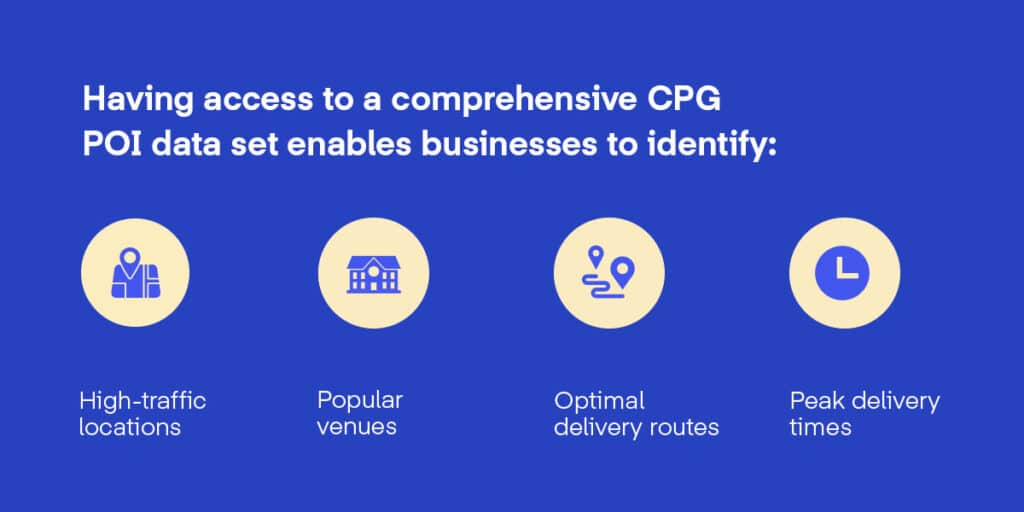
- High-traffic locations
- Popular venues
- Optimal delivery routes
- Peak delivery times
These insights are highly valuable for determining strategic and informed distribution plans that empower optimal efficiency, reduce distribution costs and ensure your business is meeting target consumers in places where they are already spending their money.
By improving these logistical processes, brands can also foster optimized supply chain management, supporting greater scalability and long-term growth. POI data can help you avoid spending money on distribution to locations where your target customers are not currently exploring, saving time and resources you can invest in getting your products in the right locations instead.
4. Comprehensive Competitor Analysis
Point-of-interest data can also be highly beneficial for conducting a comprehensive competition analysis in the consumer packaged goods industry. Your brand can explore valuable insights about their competitor’s distribution strategy, such as:
- Store locations
- Market presence
- Consumer reach
- Plans for expansion
Gathering insights about competitor brands is easier than ever with the help of advanced technologies, like artificial intelligence, that can collect and analyze data more accurately and efficiently than a human.
With a greater understanding of your competitors, your business can effectively identify opportunities for improvement and the tactics that give you a competitive edge in your specific industry.
POI data also enables CPG brands to determine where there are gaps in the market and the destinations where their products can shine.
5. Accurate Sales Forecasting
Another key application of consumer packaged goods POI data is effectively predicting future sales. By closely analyzing the location-specific insights from POI data, businesses are better able to predict demand, adjust inventory levels and optimize production.
With more accurate forecasting capabilities, your brand can anticipate consumer needs, make strategic decisions to foster greater satisfaction and protect your bottom line.
When your company knows what to expect from consumers, it can deliver the right products at opportune times in the most profitable locations.
In addition to informing resource allocation and saving your brand significant costs, accurate forecasting can help your business identify new opportunities for growth and mitigate potential risks.
6. Enhanced Merchandising and Assortment Planning
Point-of-interest data also helps consumer packaged goods brands optimize their merchandising and assortment planning strategies. Your business can analyze POI data to gain a more in-depth understanding of your target consumer’s preferences and shopping patterns at various locations. Using these insights, your company can then tailor the available product assortments and placements to optimize sales.
Brands can also leverage POI data to determine which promotional strategies are most advantageous for meeting consumer wants and needs in different locations.
POI insights offer direction for product selection, placement, price and promotion. Tailoring your merchandising tactics to the point of interest can help your business optimize its in-person presentation to supercharge sales.
7. Strategic Product Launches
Finally, you can also leverage CPG POI data to identify key locations for new product launches. If your business is interested in testing ideas and seeing how different merchandise performs, paying attention to POI insights can help you determine where to sell your latest goods to gain product exposure and boost initial sales.
Analyzing this data can help consumer packaged goods brands strategically approach new launches in the destinations where they are most likely to perform well and reach the intended consumer.
Kickstarting the sale of brand-new items in the wrong locations can cost your business in the long run. POI data gives you a holistic view of the market so you can set your product launches up for success and work off that momentum to drive revenue.
Contact dataplor to Start Leveraging Location Intelligence Across the World
If you’re looking to maximize the use of POI data for your consumer packaged goods brand, turn to dataplor. We can help you take advantage of robust artificial intelligence-driven resources and location-based insights from hundreds of locations in real-time.
dataplor helps businesses identify new opportunities to supercharge growth and achieve new levels of success with unmatched global POI datasets. We offer the most comprehensive data available to help your brand increase sales, outdo the competition and make smarter, data-backed business decisions.
Are you interested in learning more? Contact dataplor to connect with our data experts today.

Get the full story
Subscribe for the latest on location intelligence, places data, and the trends behind better business decisions.
How Wolt Strengthened Their Selection Insights with dataplor
Case Studies
How Wolt Strengthened Their Selection Insights with dataplor
Wolt’s Geospatial Evolution with dataplor
Wolt, a leading food delivery and technology company spanning 27 countries, initiated a transformative journey to enhance its market presence and identify untapped areas of opportunity. This case study explores why Wolt chose to partner with dataplor over other providers, the problems they sought to solve, and the remarkable accomplishments they’ve achieved through this partnership. Additionally, we delve into their future plans for innovation with dataplor.
Why dataplor?
Wolt’s decision to partner with dataplor was driven by their commitment to data coverage. They prioritized crucial factors such as the breadth of coverage, data accuracy, attributes and most importantly, data quality. dataplor surfaced as the top selection due to its ability to capture a vast number of Points of Interest (POIs) accurately and comprehensively. Wolt underwent an extensive evaluation process, exploring various data vendors. However, dataplor’s unmatched coverage and quality positioned it as the undeniable winner.
The Problems to Solve
Wolt aimed to leverage the data to enhance its market understanding and improve internal operations. They sought to evaluate data beyond their existing data sources to gain a more comprehensive view of merchants across various sectors, not just limited to restaurants. With dataplor, Wolt could address market gaps and identify untapped opportunities more effectively.
How Wolt Uses the Data Internally
Internally, Wolt extensively utilizes dataplor’s data to strengthen its competitive positioning and identify new opportunities. They integrate this data into their internal systems, serving it to Customer Relationship Management (CRM) platforms and ingesting it into various geospatial platforms. Wolt emphasizes the importance of data quality, recognizing it as the foundation for their operations. Centralizing processes enables Wolt to allocate resources efficiently, prioritize leads based on internal valuation, and enhance the accuracy of their predictive models.
Achievements with dataplor Data
Wolt’s collaboration with dataplor has yielded significant achievements. By leveraging dataplor’s comprehensive POI data, Wolt has improved its ability to serve customers and accelerate its growth in various markets. The integration of dataplor’s data has expanded Wolt’s market by nearly 40% in certain markets surpassing their initial projections. Wolt now possesses a more accurate and detailed understanding of merchants within their countries, enabling them to make informed decisions and capitalize on market opportunities effectively.
Background of Wolt’s Geospatial Focus
Leading Wolt’s geospatial initiatives, Sharat Ramamani brings a diverse background in strategy and analytics to the table. His journey into the geospatial realm began at Doordash, where he focused on new country expansion and selection. Following Doordash’s acquisition of Wolt, Sharat shifted his focus primarily to Wolt’s selection strategy across their 25 markets. Despite the challenges of navigating the early geospatial SaaS landscape and the initial learning curve, Sharat found the transition fruitful. Leveraging geospatial data has accelerated Wolt’s decision-making processes and accelerated their time to market.
Wolt’s strategic partnership with dataplor has transformed its approach to market development and expansion. By prioritizing data quality, accuracy, and innovation, Wolt is poised to continue its trajectory of growth and success, leveraging dataplor’s invaluable contributions to drive informed decision-making and capitalize on market opportunities effectively.
Join us on May 16th at the SDSC Conference in London, to hear from Wolt’s Analytics Lead, Sharat Ramamani and dataplor’s Enterprise Account Executive, Meagan Vigil firsthand.
Get the full story
Subscribe for the latest on location intelligence, places data, and the trends behind better business decisions.