Turn Global Location Data Into Confident Decisions

Feb 05, 2026 / 4 min

Turn Global Location Data Into Confident Decisions

Blog

Location intelligence has become foundational to how organizations evaluate markets, allocate capital, and plan for growth. From expansion planning to risk assessment, understanding where activity happens in the real world increasingly shapes strategic decisions. Yet despite the volume of data available today, many teams still struggle to translate location data into clear, actionable insight.

The challenge is not access. It is usability, consistency, and global reliability.

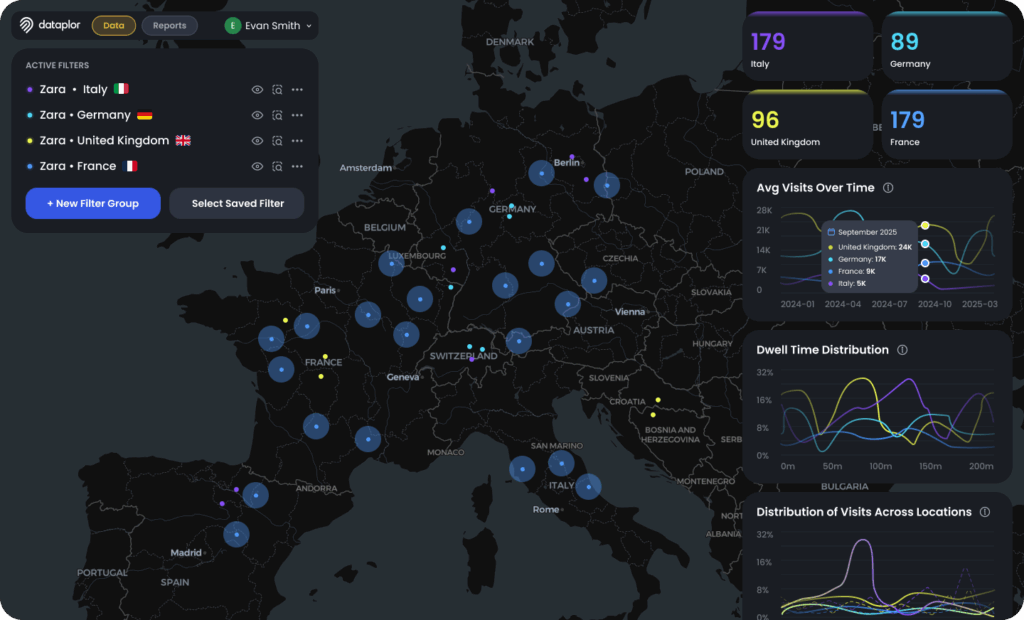
Dataplor’s Global Platform was built to solve that problem. It gives teams a clearer, faster way to see where places are, and how people move through the physical world to understand market operations at global scale.

Why Location Intelligence Needs to Evolve

As companies expand into new regions and rely more heavily on location-driven data, existing tools often fall short.

  • Global coverage breaks down outside major markets.
  • Data quality varies by region and category.
  • Analysis requires stitching together disconnected datasets.
  • Insights take too long to synthesize to inform real-time decisions.

These gaps create uncertainty, and in competitive markets, uncertainty translates directly into missed opportunity.

Our platform brings accurate global places data and foot traffic insights into a single, intuitive experience designed for how teams actually work today. It replaces fragmented workflows with a unified view of markets that supports faster and more confident decision-making.

Built for Scale & Accessibility

Dataplor’s Global Platform is designed to be powerful without complexity .

Business, strategy, and analytics teams can explore data directly without writing queries or managing multiple tools. And importantly, underneath the hood our platform is backed by Dataplor’s continuously refreshed global dataset, consistent schema, and privacy-first approach to foot traffic data.

This combination ensures teams can trust the insights they’re drawing from the data, regardless of region and across diverse use cases.

A Visual Approach to Market Intelligence

The platform centers on an interactive global map that allows users to explore markets visually, rather than through static tables or rigid dashboards.

Teams can move fluidly from a global view to regional comparisons and down to individual locations. They can analyze brand presence, category density, visitation trends, and market patterns without needing technical expertise or specialized tooling.

This visual approach matters because most location questions are exploratory by nature. The platform is designed to support investigation, comparison, and iteration, making it easier to uncover patterns, validate assumptions, and refine strategy.

How Leading Teams Use the Platform

The Platform is designed to support a wide range of industries and decision types. In practice, teams use it to answer questions like these:

Consumer Packaged Goods (CPG)

Where does our retail coverage actually exist, and where are we missing opportunities?

For CPG teams, distribution strategy depends on understanding where independent and regional retailers truly operate, especially outside large national chains.

The platform helps teams map retail presence across markets, identify whitespace where distribution is limited, and compare category density across cities and countries. This visibility allows teams to prioritize expansion based on real-world activity rather than incomplete or outdated lists.

Commercial Real Estate (CRE)

How do locations perform, and what signals indicate future growth?

Commercial real estate teams need to understand both where properties are located and how those locations function within their surrounding environment.

Using the platform, teams analyze tenant mix, foot traffic patterns around assets and corridors, and market dynamics across regions. This makes it easier to compare opportunities consistently and spot early signals of neighborhood change.

Financial Services

What is happening on the ground before it impacts operations and shows up in financial reporting?

For financial and investment teams, location data adds an important layer of real-world validation.

The platform allows teams to track physical expansion or contraction of brands, validate investment theses using inputs like visitation trends, and monitor activity in emerging or underreported markets. These insights help ground financial analysis in observable market behavior.

A Clearer View of the World

Markets are constantly changing. Stores open and close. Consumer behavior shifts. And new opportunities emerge faster than traditional data sources can capture.

Our platform helps teams see those changes sooner, understand them more clearly, and act with confidence.

By turning global complexity into an intuitive visual experience, the platform enables better questions, faster insight, and stronger decisions. 

Ready to get started?

Dataplor Launches New Global Location Intelligence Platform, Delivering an Intuitive & Precise Analysis of Places Worldwide and How the World Interacts with Them.

From Signal to Strategy: How Location Intelligence Is Evolving for Financial Markets

Dec 18, 2025 / 4 min

From Signal to Strategy: How Location Intelligence Is Evolving for Financial Markets

Blog

Alternative data has entered a new phase. At the Neudata NY Winter Data Summit, discussions with financial services and investment professionals pointed to a clear shift: location intelligence is no longer evaluated as an experimental dataset, but as a core input into how firms understand markets, companies, and consumer behavior in near real time.

What stood out most wasn’t a single new use case or dataset, but a broader shift in how investment professionals are thinking about scale, specificity, and signal quality when it comes to location-based data.

The Rise of Investment-Grade Location Data

Across hedge funds, asset managers, and private equity firms, there is a growing expectation that alternative data must map cleanly to financial instruments. High-level foot traffic trends or regional summaries are no longer sufficient on their own.

What investors are asking for instead is location data that maps cleanly to how capital is actually deployed. That means: 

  • Ticker-aligned reporting that ties real-world activity directly to public equities
  • Brand- and category-level consistency to support cross-company comparisons
  • Open and close visibility to distinguish temporary volatility from structural change

These capabilities allow real-world activity to be translated into insights that are comparable across companies, regions, and time. In short, location intelligence is being held to the same standards as traditional financial data—if it can’t support rigorous analysis, it won’t be used.

Global Coverage Is the Differentiator That Matters Most

While U.S. data remains table stakes, what generated the most interest at the summit was coverage beyond domestic markets. Investors increasingly recognize that alpha is harder to find where everyone is looking and that international markets often offer earlier, indicative signals.

Global location intelligence enables teams to:

  • Identify leading indicators in undercovered markets
  • Monitor multinational brands consistently across regions
  • Evaluate expansion strategies and demand shifts outside the U.S.
  • Support portfolios that span North America, Europe, and beyond

Complementary Data, Not Just More Data

Another recurring theme was the reality that most investment organizations already have a wealth of data. The challenge is not access, it’s integration. Teams are actively looking for datasets that complement existing models rather than duplicate them. Location intelligence stands out because it provides real-world validation of trends that may first appear in financials, earnings calls, or consumer data. 

Used correctly, it can serve as:

  • A leading indicator ahead of reported revenue
  • A real-world check on company narratives and performance claims
  • A way to understand how broad market trends play out on the ground

In this sense, geospatial data is increasingly viewed as connective tissue that bridges qualitative narratives and quantitative outcomes.

From Public Markets to Private Capital

These dynamics extend well beyond public equities. Private equity, private credit, and real estate investors are increasingly applying location intelligence to due diligence, portfolio monitoring, and geographic expansion analysis.

As portfolios grow more international, consistent visibility across markets becomes critical. Location data helps private investors understand how assets perform on the ground, not just in financial models—particularly for consumer-facing businesses with physical footprints.

Why This Moment Matters

The overarching message from Neudata was clear: location intelligence has matured. Investment teams expect data that is globally consistent, analytically rigorous, and ready to integrate into existing workflows.

This is exactly where Dataplor supports financial services organizations. With global places and foot traffic coverage, consistent brand and category labeling, and visibility into store openings and closures, Dataplor helps investors translate real-world activity into investment-ready signals.  For teams trading equities, managing global portfolios, or evaluating expansion strategies, this means having consistent signals they can use across regions, brands, and asset classes to make faster and better decisions.

As alternative data becomes more embedded in investment processes, the ability to rely on scalable, investment-grade location intelligence is no longer a differentiator. It is a requirement.

If you’re evaluating how global location intelligence and foot traffic data can function as leading indicators within your investment process, the Dataplor team is here to support.

How High-Quality Global Places & Foot Traffic Data Unlock Efficiency & Market Growth

Dec 09, 2025 / 4 min

How High-Quality Global Places & Foot Traffic Data Unlock Efficiency & Market Growth

Blog

Expanding across geographies is one of the most powerful ways an enterprise can grow, but it’s also one of the most complex. Different regions operate at different levels of digitization, sales teams often rely on inconsistent data, and organizations struggle to maintain visibility across multiple markets. The companies that break through these challenges all share one foundational element: they rely on high-quality, globally consistent data.

Traditionally, companies have had to choose between two types of providers: those with strong places, also known as point-of-interest (POI), data or those with strong foot traffic data. High-quality, globally consistent places data gives teams a clear picture of what exists. Foot traffic shows how people actually interact with those places. But to truly understand market dynamics, competitive environments, and real-world consumer behavior, organizations need the strength of both datasets. But, it’s rare to find a partner that consistently delivers both.

When global coverage, accuracy, and trend patterns come together, organizations can make sharper decisions, open new markets with confidence, and dramatically increase the productivity of their sales teams. We explore how this combination of global reach, reliable data quality, and sales enablement transforms performance across industries.

Global Coverage Without Compromise

For global enterprises, incomplete or inconsistent data is more than an inconvenience, it’s a barrier to intelligent expansion. Many vendors offer basic places data, but fall short once you move beyond a handful of well-digitized markets. Others offer foot traffic insights, but only in select regions, leaving major gaps in global strategy.

A unified dataset solves this by ensuring every market is supported with the same level of quality and standardization. This allows organizations to:

  • Evaluate total addressable markets more accurately
  • Standardize data structure and definitions across regions
  • Reduce technical effort tied to reconciling disparate datasets

This consistency gives leaders the clarity they need to prioritize the right opportunities across dozens of markets and multiple business units. When the entire organization works from the same data foundation, strategy becomes clearer and far more scalable.

Quality & Accuracy: The Foundation of Better Outcomes

Global coverage is essential, but coverage alone is not enough. The accuracy and reliability of places and foot traffic data determine whether strategies succeed or fail. A lack of robust, comprehensive data creates costly downstream effects; misleading attributes, outdated statuses, or misaligned categories can lead to wasted sales activity, flawed models, and misinformed decisions.

This is precisely why high-quality data is characterized by:

  • Rigorous vetting and validation
  • Standardized schemas across markets
  • Reliable update cadences teams can rely on

This level of quality builds trust. It ensures analytics teams, sales leaders, and field reps all work from the same dependable bedrock. When organizations no longer worry about whether the underlying data is correct, they can redirect focus on what matters – execution and innovation.

How Teams Put Places & Foot Traffic Data to Work

Once organizations have a clear view of what exists in each market and how those locations behave, teams across industries can use this information to evaluate opportunities and reduce uncertainty. 

Financial services firms leverage places and foot traffic data to assess the commercial strength of potential markets. By reviewing business density, category mix, and visitation trends, they can identify areas with strong economic activity and steer clear of locations with weaker fundamentals. This helps them deploy capital in places with a higher likelihood of sustained performance.

Commercial real estate teams rely on this data to evaluate the viability of potential sites. They examine nearby amenities, competitive presence, and then employ foot-traffic behavior to determine whether a property is well-positioned for tenant success. This layered approach to data helps reveal market strengths, potential gaps, and long-term supply-and-demand patterns that might otherwise have gone undiscovered through surface-level observations.

Retail and CPG companies use places and foot traffic data to understand store network performance, find white space for expansion, and assess competitive saturation. A brand evaluating new store locations can analyze nearby retailers, customer movement patterns, and surrounding business mix to identify areas with strong shopper activity. This same data helps CPG teams understand where their products are likely to reach the most consumers and which markets have unmet demand.

The Future Has Yet to Be Realized

The location intelligence landscape is evolving. AI is accelerating how data is collected, and open-source mapping ecosystems are reshaping expectations around availability and cost. But even as data becomes more abundant, most providers still specialize in either places or foot traffic; very few have the infrastructure to deliver both at global scale with enterprise-quality standardization.

Organizations poised for long-term success will be the ones who invest in a strong data backbone now—one that combines global places coverage with high-quality foot traffic insights and maintains the highest standards for accuracy. Separately, these two datasets are mere inputs, combined they become a strategic advantage.

At dataplor, we’re committed to delivering our clients that advantage with the clarity, consistency, and global perspective required to grow smarter and execute faster. Let’s connect today.

Connecting Clicks to Footsteps: A Retailer’s Guide to Store Visit Attribution

Nov 17, 2025 / 5 min

Connecting Clicks to Footsteps: A Retailer’s Guide to Store Visit Attribution

Blog

Digital campaigns deliver endless performance metrics, impressions, click-throughs, engagement rates, but none of them tell you whether customers actually step inside your stores. For retail marketers, that disconnect between digital engagement and physical action has long been a blind spot.

Store visit attribution changes that. By linking online marketing efforts to real-world foot traffic, it helps retailers understand which campaigns truly drive visits, not just clicks. This visibility transforms marketing performance from guesswork into strategy, allowing businesses to make smarter, data-backed decisions about where to invest and how to engage their audiences.

What Is Store Visit Attribution?

Store visit attribution measures how digital marketing influences in-person behavior. It connects the dots between a customer seeing an ad and later walking through your doors. With the right data infrastructure, retailers can see which channels and messages lead to actual store visits, revealing the real ROI of their marketing spend.

Without it, many campaigns are optimized for online metrics alone. That can lead to poor decisions such as pausing initiatives that quietly drive store visits or over-investing in ads that look good on paper but fail to convert offline. Store Visit Attribution fills those gaps, showing the complete customer journey from awareness to action.

How It Works

Modern store visit attribution relies on a combination of technologies and data sources to paint an accurate picture of real-world behavior:

  • GPS and mobile location services confirm when a consumer who viewed an ad later visits a store, using anonymized, consent-based data.
  • Wi-Fi and beacon tracking verify visits by connecting devices to in-store networks or proximity sensors.
  • First-party data, such as CRM or loyalty program records, link known customer interactions across channels.
  • Third-party attribution platforms integrate multiple data streams (ad impressions, location data, and purchase behavior) to provide a holistic view of performance.

Each of these elements contributes to a single goal: understanding how digital actions translate into real-world visits, while maintaining privacy and accuracy at every step.

Why It Matters for Retailers

Store visit attribution does more than validate marketing efforts, it transforms how retailers plan, execute, and measure success. Retailers who connect online and offline data consistently see higher returns on ad spend and greater customer loyalty.

It delivers three key benefits:

  1. Proving and Improving ROI: By identifying which campaigns drive in-store visits, retailers can confidently reallocate budget to what works best, reducing wasted spend. McKinsey reports that retailers linking digital and physical data see up to 20% higher marketing ROI.
  2. Understanding the Customer Journey: Shoppers rarely follow a straight path from ad to purchase. They might discover a product on Instagram, research online, and then visit a store days later. Attribution connects those touchpoints, revealing the sequence that leads to conversion.
  3. Localizing Marketing Strategies: For brands managing multiple locations, attribution enables more effective local targeting by tailoring messages by region or audience segment, launching promotions that align with local behavior, and adjusting ad spend based on actual foot traffic.

Beyond marketing, attribution insights extend across operations. Retailers can anticipate peak periods to optimize staffing, align inventory with expected demand, and even identify new trade areas for expansion. When used strategically, store visit attribution becomes a vital source of business intelligence—not just a marketing metric.

Challenges and Considerations

Implementing store visit attribution requires a balance between data accuracy, privacy, and technical integration.

Key challenges include:

  • Privacy and Compliance: Data must always be anonymized, consent-based, and compliant with regulations like GDPR and CCPA. Transparency about what’s collected and how it’s used builds trust.
  • Accuracy and Dwell Time: Not every signal equals a store visit. Setting a dwell-time threshold—such as five minutes or more—helps filter out false positives like a passerby.
  • Cross-Device Tracking: Customers interact across phones, tablets, and laptops. Linking these touchpoints accurately is essential to understanding the full journey.
  • Attribution Windows: Retailers must define how long after an ad exposure a store visit should count based on typical buying behavior.
  • Data Integration: To be truly useful, attribution data must connect seamlessly with CRM, POS, and ad systems. Without integration, valuable insights remain siloed.

Navigating these challenges requires both robust technology and trusted data partners who specialize in global, privacy-conscious location intelligence.

Making Attribution Work for You

Retailers beginning their attribution journey should start by setting clear goals. Whether the aim is to improve ROI, understand customers better, or make smarter operational decisions, clarity upfront ensures the right data strategy and technology choices.

To maximize results:

  • Layer multiple data sources for a complete view of performance.
  • Validate insights regularly to ensure ongoing accuracy.
  • Integrate findings across teams so that marketing, operations, and strategy all benefit.
  • Evolve continuously. Consumer habits and technologies change—so should your attribution approach.

Attribution is not a one-time setup; it’s a living framework that evolves with your business.

The Future of Retail Marketing

As the line between digital and physical retail continues to fade, the ability to measure both worlds in tandem has become a defining advantage. Store visit attribution empowers brands to connect engagement with real-world outcomes, turning every campaign into a measurable, actionable insight.

Retailers that embrace this approach are better equipped to navigate the complexities of an omnichannel world. With accurate, privacy-first location data, they gain the clarity to invest wisely, personalize experiences, and operate more efficiently across every market.

If you’re ready to understand what drives customers from click to visit, let’s start the conversation.

Redefining Real Estate Intelligence: Key Insights from CREtech

Nov 05, 2025 / 3 min

Redefining Real Estate Intelligence: Key Insights from CREtech

Blog

Conversations at this year’s CREtech conference revealed the real estate industry is ready to modernize—especially around how data, AI, and predictive modeling can drive better investment and property decisions.

Themes like site selection, property valuation, and localized market analysis dominated discussions. But underneath those topics was a shared recognition: the industry can’t continue to lean on instinct the way it has in the past. Reliable, transparent, and up-to-date data continues to expand as the foundation for competitiveness.

Urgency for Data Confidence

Across panels and networking sessions, it was made clear that data quality directly determines decision quality. Many attendees shared their frustrations with incomplete or unreliable datasets, especially around foot traffic, multi-tenant properties, and fast-changing markets.

This trust gap has created hesitation. Commercial real estate (CRE) professionals know they need to adopt modern data strategies but remain skeptical after years of inconsistent vendor performance. The priority now is confidence, not just access to data, but assurance in its accuracy, origin, and freshness.

dataplor helps bridge that gap by delivering accurate, current, and context-rich datasets that reflect real market conditions. Each record is consistently validated and refined to ensure reliability across regions and property types. This level of precision gives CRE teams the confidence to evaluate opportunities, benchmark performance, and guide investment strategies with data they know they can depend on.

AI is Only as Good as its Inputs

AI and predictive modeling were the most discussed technologies at CREtech. Yet the excitement came with a warning: without reliable inputs, advanced modeling can produce misleading results.

Many organizations are rushing to adopt AI for site selection, portfolio optimization, and property valuation, but lack the clean, consistent, and current data necessary to support those models. The takeaway is simple: AI is only as smart as the data that feeds it.

dataplor’s global POI and foot traffic datasets provide high-quality, structured data that integrates seamlessly into clients’ backend systems. This foundation ensures that predictive tools and AI-driven workflows can operate on reliable, reality-based insights.

[Local] Context is Everything

Another theme gaining momentum across CREtech was the demand for deeper local context. Investment decisions are increasingly influenced by neighborhood-level factors: nearby business openings and closures, local consumer activity, and shifts in foot traffic patterns.

Traditional CRE data often stops at financials or property-level indicators, missing these critical layers of environmental intelligence. As competition intensifies, investors and analysts need to understand not only what is happening in a market but why.

dataplor’s robust datasets deliver precisely this context through verified POI data, open and closure tracking, and reliable foot traffic insights. These inputs enable teams to evaluate areas for growth with confidence and anticipate changes before they surface in traditional metrics.

Trust Through Transparency

Perhaps the most important shift at CREtech was a philosophical one. The industry is moving away from the “black box” mentality of opaque data providers and toward collaboration and transparency.

CRE professionals aren’t just looking for more data—they’re looking for data partners who can help interpret, validate, and apply insights effectively. The emphasis has moved from buying data to building confidence.

dataplor’s commitment to transparency, human validation, and customer partnership resonated strongly with attendees. By aligning our methods with clients’ expectations and clearly communicating what our data represents, we help bridge the gap between information and action. 

If you’re in a place to see your markets more clearly, let’s connect

Unlocking Competitive Edge with Customization & Expansion: What We Heard at NACS & Why it Matters

Oct 29, 2025 / 3 min

Unlocking Competitive Edge with Customization & Expansion: What We Heard at NACS & Why it Matters

Blog

Retailers and brands today are navigating a more competitive and dynamic marketplace than ever before. The questions they’re asking: Where should we open next? How do we stack up against competitors? How can data drive smarter expansion? came through loud and clear at this year’s NACS conference

These aren’t new topics to retail planning or location intelligence, and each of these themes points to the same truth: success depends on seeing your market clearly, understanding it deeply, and acting with confidence. Brands and retailers want to tell a better story with their data about the consumer journey, competitive presence, and market movement.

Competitive Visibility Isn’t Optional Anymore

Knowing your competitors exist isn’t enough, you need to see where they’re opening, closing, and gaining traction. Many data teams we speak to still rely on fragmented or outdated sources to understand market shifts. Without clear visibility, even the most sophisticated brands are left making educated guesses. The result? Missed opportunities or misguided investments in the wrong areas.

To solve this, companies are prioritizing data consistency and global coverage, building comprehensive views of their competitive landscape that combine location, performance, and context. When you can see both where competitors are and how their networks are performing, decisions become clearer and more confident.

Customization is the New Must-Have

Many attendees at NACS shared frustrations with rigid platforms that box them into predefined geographies and dashboards. Without flexibility, brands are forced to work around their technology rather than with it, which slows insight and stifles innovation. Each market behaves differently, and a static approach doesn’t capture those nuances.

To overcome this, companies are looking for products that allow for true customization, including the ability to define and monitor their own trade areas, visualize store networks the way they operate, and measure success on their own terms. That kind of adaptability gives teams ownership over how they see and use data.

Smarter Market Expansion Starts with Context

For many growing brands, site selection and expansion decisions are still made based on intuition rather than evidence. Choosing new locations without full market context can lead to costly missteps like a store that opens in an area with declining foot traffic, or a product placed where nearby businesses are closing. The consequences ripple through budgets, operations, and long-term growth.

The teams we spoke with are eager to change this; they want to move from guesswork to grounded strategy and understand not just where growth looks possible, but why. That means looking beyond the site itself to the surrounding ecosystem: business density, consumer activity, and local market momentum.

To make smarter decisions, companies are turning to data-driven site selection and market intelligence, layering location insights with trends and context. With this holistic view, expansion becomes strategic, not speculative.

From Local Insight to Global Impact

One of the most impactful conversations we had at NACS was with a professional responsible for product placement in small, independent retailers across emerging markets. Her challenge was scale: how do you find the right local shops when reliable data simply doesn’t exist?

That’s where dataplor’s global coverage becomes essential. 

dataplor’s global POI and mobility data empowers brands and retailers with a complete picture of their markets by showing where competitors are located, how frequently they open or close, and how consumers engage with those places. Users can create and track fully custom geographies, analyze performance by region, and visualize insights that align with their business goals. This helps teams evaluate potential markets with confidence, understand what is happening and why, and make faster, more focused, data-driven decisions.

As the conversations at NACS made clear, growth today depends on clarity not just collecting data, but connecting it to the questions that matter most. With the right visibility, flexibility, and context, brands can navigate change with confidence and turn information into meaningful action. If you’re ready for that action, we’d love to chat